The City of Marshall has announced its performing arts season schedule for Memorial City Hall Performance Center. The premier season will run from October 2019 to April 2020, and features a variety of acts for all ages, from boogie-woogie blues to Texas-legend country music to classic rock-n-roll, and much more.
Marcia Ball will serve as the opening act on Saturday, Oct. 26, to officially open Memorial City Hall Performance Center, a beautifully restored 552-seat auditorium with professional sound, recording, video and new seating. Ball, the “2018 Texas State Musician of The Year,” has won worldwide fame and countless fans for her ability to ignite a full-scale roadhouse rhythm and blues party every time she takes the stage. Her rollicking Texas boogies, swampy New Orleans ballads and groove-laden Gulf Coast blues have made her a one-of-a-kind favorite with music lovers all over the world. Other acts scheduled to perform during the premier season of Memorial City Hall Performance Center include: Gary P. Nunn, a nationally-known Texas Country artist, on Saturday, Nov. 9; Celtic Angels Christmas, an internationally-known Irish vocal quintet group featuring a true holiday celebration of Christmas in Ireland, on Thursday, Dec. 19; Farewell Angelina, an all-female country group featuring a stellar blend of heartstopping harmonies over blazing double violins and guitars, on Friday, Jan. 24; One Night in Memphis, a tribute band to legendary Sun Records recording artists Carl Perkins, Johnny Cash, Jerry Lee Lewis and Elvis, on Saturday, Feb. 15; Aquila Theatre: 1984, will feature a group of performers that will bring “1984,” George Orwell’s cautionary novel to the stage, on Saturday, March 20; wrapping up the season will be The Wonder Bread Years, a fresh and funny salute to Americana, will feature a fast paced, hilarious production that gracefully walks the line between stand up and theater, on Friday, April 17.
“I think we’ve put together an outstanding line up for our inaugural performing arts season that will appeal to all ages and styles,” said Memorial City Hall Performance Center Manager Glenn Barnhart. “We wanted a diverse set of acts and I believe we have delivered on that front—you have musical acts, theatrical productions, a comedy show—so there are things that will appeal to everyone.”
The inaugural performing arts season is presented in association with the Marshall News Messenger and KMHT Radio. Single ticket sales for all shows will begin on Monday, Sept. 23.
For more information on Memorial City Hall Performance Center, the performing arts season, ticket sales and rental and membership opportunities, contact Barnhart at 903-934-7992 or visit: memorialcityhall.com.
GIVE US YOUR FEEDBACK. CLICK ON “COMMENT” TO TELL US WHAT YOU THINK or use one of the alternative methods for providing feedback.
How
many crises can can nation handle at one time and still remain viable on the domestic
and international stage?
Anyway
you look at it, the United States is about at capacity.
Every
presidency – EVERY single one – has crises, some more than others, but the
tenure of some presidents — Ike
Eisenhower comes to mind – combine personality with a specific time in history
with few internal and external negative situati0ns and comes away practically
unscathed as to reputation and the way they handled certain situati0ns that had
the makings of a great train wreck.
It
is safe to say President Donald Trump thrives on conflict, goes out of his way
to create damning headlines, daily antagonizes those he considers enemies via
bombastic tweets and feeds lines and lines of literary red meat to his rabid followers.
He constantly and purposefully chunks word-grenades at those he considers
inferior to himself, which is just about anyone who is not family, does not
kowtow to every utterance, refuses to kiss the hem of his tunic or only sh0ws
tepid support for the latest and greatest brain drizzle.
Under
Trump, the citizens of the world have been receiving a regular heaping helping
of crisis du jour. Think about it: It
seems everyone discusses the “latest’ crisis over morning coffee or in the car
pool driving to work. After lunch, conversation turns to the newest
presidential edict, executive order, slap-down of a foreign leader, key White
House or agency resignation or simply surmising what is going to jump from
Trump’s fertile mind to his fingers before sunset.
Program! Program! Get ya program!
You can’t keep up with the crises without a program!
Admitting
to be a news junkie is not hard for me, having spent almost 50 years in
newspaper executive posts in four states; banner headlines or on-target
analysis of current events are my pers0nal drug of choice. I often think in
headlines, in snippets of sentences fashioned to make a
grab-the-reader-by-the-eyeballs story lead and in creating a memorable
take-away ending.
Trump,
while decrying any media attention he deems “unfair,” is a publicity
prostitute. The electronic media-savvy reality show host turned president did
whatever it took – blasting out absurd tweets, attacking specific members of
the media (including some on his beloved Fox News), heaving verbal salvoes at
anyone and any organization that dared hint he was wrong about anything – to create an aura of
invincibility.
In
the first 32 months of his presidency, Trump has personally initiated more
national and global crises than the last five presidents combined. His list of
“Oh boy! incidents range from the ridiculous to the ridiculouser.
He
petulance is apparent daily in his multiple tweets (he is average seven tweets
a day for a total of more than 6,400 so far in his first term) as he picks word
fights with everyone from his media detractors, foreign leaders who question a
particular action, celebrities who dare to use their status to questi0n his
decisions or to create internal strife within his own cabinet.
The
president’s desire for empirical power is not a ruse; he truly would love it if
he could run the United States as a strong-arm dictatorship. Thus, his
affectati0n with dictators and despots around the world.
Honestly,
looking at it from as an objective viewpoint as possible, Trump is his own
worst enemy. He created the multiple crises that will define his presidency for
history.
He is
pers0nally responsible for:
The rise of
visibility of the white supremacy movement by refusing to condemn violent
actions at a number of sites;
The continuing,
heart-breaking saga of the deplorable, for-profit immigration detainee camp and
the inexcusable separation of children from family members;
The constant
ballyhoo for the “Trump Wall” without even taking into consideration that there
was only one wall in history that keep ‘invaders” out (the Great Wall of China)
and that high-tech surveillance gear would do the job of detecting smuggling
efforts of people and drugs better and cheaper;
The runaway
deficit shows no sign of abating, nor is it a priority item of the president;
Trump’s
trade policies are an example of his “take-action-then-think-of-consequences”
management style, which creates confusion and fiscal harm to suppliers o0f
producers and results in higher prices for consumers;
His attacks
on minorities undermines the fabric of the truism that “we are all
Americans’;
His constant
lies on anything and everything are so transparent that few things he says are
taken seriously by knowledgeable observers, which is a serious problem for the
most powerful man in the world…and the world; and
His failures
in business, unseemly embracing of foreign dictators, refusal to accept facts
garnered by his intelligence agencies about foreign enemies, dust-ups with
foreign allies for no apparent reason, breaking treaties that protect the best
interests of this nation … all point to a person of power who does have the
knowledge, the temperament, the intelligence nor the ethical fortitude to be
president.
Trump must be a one-term president. The 2020 elections will
decide whether the people the United States are ready to get rid of this Grand Experiment
and put an adult back in charge of the affairs of state or continue the status
quo.
GIVE US YOUR FEEDBACK. CLICK ON “COMMENT” TO TELL US WHAT YOU THINK or use one of the alternative methods for providing feedback.
When considering what is meant by “patriotism,” I find it useful to recognize two kinds of patriotism:
1. Elitist Patriotism
2. Non-Elitist Patriotism
Elitist patriotism is the worst kind of patriotism. Elitist Patriotism is a harmful, nationalistic form of patriotism holding that people of a particular country are somehow better or more worthy of having their rights upheld or lives saved than people of other countries. Elitist patriotism fails to recognize “unalienable rights,” the universal human rights described by the founding fathers of the United States (in the Declaration of Independence) as being intrinsic to all human beings, regardless of their nationality. Instead, elitist patriotism is “elitist” because it only recognizes rights of people who are citizens or even a subset of citizens of a given country, such as those of a particular religion or race. Instead of judging someone based on their character, elitist patriotism considers someone favorably merely by their legal status of being a member of a particular nationality. Elitist patriotism tends to be indifferent to or even in favor of exploiting, harming, or killing people of other nationalities because other nationalities are regarded as having intrinsically less worth. Elitist patriotism promotes conformity and is threatened by dissent and individuality. Thus, elitist patriotism is incompatible with the views of founding father, Thomas Jefferson, who said, “Dissent is the highest form of patriotism.”
Non-elitist patriotism is the best kind of patriotism. Non-elitist patriotism is a patriotism of good ideas, such as honoring life, individual liberty, the pursuit of happiness, and freedom in general. Because non-elitist patriotism is a patriotism of ideas, it transcends national boundaries. Because Non-elitist patriotism is a patriotism of ideas, it is physically unassailable by its enemies. Yet, because non-elitist patriotism encompasses a set of ideas, it is assailable in situations where there is a lack of awareness, including situations in which there has been a lack of education or a systematic production of ignorance through propaganda. Non-elitist patriotism practices inclusion, even for those who have dissenting viewpoints. Non-elitist patriotism recognizes unalienable rights as belonging to everyone regardless of their nationality. Non-elitist patriotism is focused on spreading its good ideas, rather than practicing imperialistic land grabs, or exercising other materialistic dominion. Rather than create nationalist borders that define the in-groups of privilege and out-groups of deprivation, non-elitist patriotism seeks to universally extend its rights and benefits to everyone, regardless of their national identity or geographical location. Of all the founding fathers of the United States, Thomas Paine probably exemplified the principles of non-elitist patriotism to the greatest degree.
As I reflect on the countless lives lost throughout human history defending elitist patriotism instead of non-elitist patriotism, I am reminded of the lyrics of John Lennon’s Imagine:
Imagine there’s no Heaven It’s easy if you try No hell below us Above us only sky Imagine all the people Living for today
Imagine there’s no countries It isn’t hard to do Nothing to kill or die for And no religion too Imagine all the people Living life in peace
You may say that I’m a dreamer But I’m not the only one I hope someday you’ll join us And the world will be as one
Imagine no possessions I wonder if you can No need for greed or hunger A brotherhood of man Imagine all the people Sharing all the world
You may say that I’m a dreamer But I’m not the only one I hope someday you’ll join us And the world will live as one
I am proud to be a non-elitist patriot who happens to live in Texas.
I imagine a day when everyone will have “nothing to kill or die for.”
GIVE US YOUR FEEDBACK. CLICK ON “COMMENT” TO TELL US WHAT YOU THINK or use one of the alternative methods for providing feedback.
People often use and react to words because of the emotions and behaviors words cause, rather than react to or seek clarification of the meaning of words used by someone.
These reactions can have drastic consequences, such as when politicians manipulate voting behavior by labeling their opponents as “liberals” or “conservatives,” which is often calculated to divert voters’ attention away from considering what politicians actually stand for or what politicians will do once they gain office.
The lack of precision of meaning in our conversations is also evident in the usually meaningless extra words that are inserted into spoken sentences, such as, “like,” “kind of like,” “sort of,” “you know,” and the classic “know what I’m sayin’?” It was sort of, like, you know, kind of like, well, you know what I’m sayin’.
Philosophers have traditionally pointed out the importance of defining our terms BEFORE beginning a conversation, yet most conversations occur with the implicit assumption that participants have the same understanding of words being used. Knowing up front what is meant by words used in a conversation is not just important in academic discourse, but in every single conversation we have. If there is any doubt, it takes only a few seconds more to ask a speaker what they mean by a particular word.
For example, I believe the word “believe” (when left undefined) is an ambiguous word that can potentially confuse the thinking of those whose use or hear it.
For example, stating what I believe could be a statement of my values, such as saying, “I believe in single-payer universal health care.” This is a statement of what I believe should ethically occur. This statement of belief does not involve taking a leap of faith or making any assumptions about the nature of reality that are not based on evidence. Rather it is a statement of what is clearly possible and of what I would like to see occur.
In contrast, another sense in which the word “believe” is used is when someone makes a statement in which they have taken a leap of faith about the nature of objective reality, usually with no evidence to support their claims. Such statements can be as seemingly innocuous as saying “I believe in God.” However, such statements of belief can also be dangerous when they have a prescription for particular behaviors, such as when someone believes their god wants them to kill, harm, or exploit others in some way.
Thus, when I hear someone use the phrase, “this I believe,” I believe I better dig more deeply as to whether they are making a statement of values (such as saying “I believe in the Golden Rule.”), or whether they are referring a leap of faith they have made about the nature of reality, especially a leap of faith involving a prescription for intolerance or behavior that might bring harm to others.
This I believe: “People should know what they mean and mean what they say.”
Know what I’m sayin’?
GIVE US YOUR FEEDBACK. CLICK ON “COMMENT” TO TELL US WHAT YOU THINK or use one of the alternative methods for providing feedback.
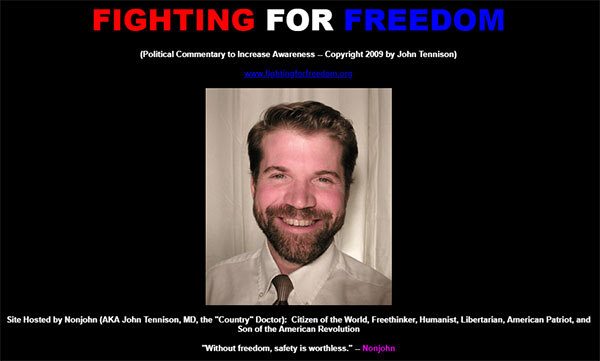
by John Tennison, M.D., (essay copyright July 4, 2007)
As we celebrate the anniversary of the signing of the Declaration of Independence on July 4th, I find it valuable to review the contents of the Declaration of Independence.
Although the phrase, “united States of America,” was used in the signed copy of the Declaration of Independence, the phrase was used in a generic sense to refer to the colonies that were united in their Declaration, rather than to refer to a sovereign nation statethat existed at the time. Since the phrase was not the formal name of a country or confederacy, the word “united” was uncapitalized on the copy that was officially signed on July 4th, 1776. However, drafts of the Declaration of Independence that existed prior to July 4th, 1776 used the word “United” in its capitalized form, suggesting that Jefferson regarded “United States of America” as a formal title for the grouping of the thirteen states, even though the group did not constitute a sovereign nation state. Moreover, in subsequent copies of the Declaration of Independence written by Jefferson after July 4th, 1776, he continued to capitalize “United,” suggesting that he wanted to include “United” as part of the proper name for the group of the thirteen states.
When ratified by Maryland on March 1, 1781, the Articles of Confederation established a confederacy formally known as “The United States of America.” However, even then, this confederacy did not constitute a singular sovereign nation state, as the second Article of Confederation stated:
“Each state retains its sovereignty, freedom, and independence, and every power, jurisdiction, and right, which is not by this Confederation expressly delegated to the United States, in Congress assembled.”
Thus, rather than being a national government, the government of “The United States of America” created by the Articles of Confederation was more analogous to that of today’s United Nations.
The country known as “The United States of America” formally began at the point the Constitution was ratified by the ninth state of New Hampshire on June 21, 1788.
The values and principles enumerated in the Declaration of Independence justified the rebellion against the British government. Even today, it is these original values and principles that deserve our unwavering allegiance, and not necessarily the government of a particular country. The authors of the Declaration of Independence were very clear on this point when they wrote:
“We hold these Truths to be self-evident, that all Men are created equal, that they are endowed by their Creator with certain unalienable Rights, that among these are Life, Liberty, and the Pursuit of Happiness – That to secure these Rights, Governments are instituted among Men, deriving their just Powers from the Consent of the Governed, that whenever any Form of Government becomes destructive of these Ends, it is the Right of the People to alter or to abolish it, and to institute new Government, laying its Foundation on such Principles, and organizing its Powers in such Form, as to them shall seem most likely to effect their Safety and Happiness.”
Thus, to the extent that a government of a particular nation no longer honors the rights and freedoms recognized by the Declaration of Independence, such a government no longer deserves the allegiance of its citizens. Consequently, on this July 4th, 2007, I ask the question, “To what should we pledge our allegiance?”
In 1892, Francis Bellamy, the author of the original Pledge of Allegiance, placed more emphasis on pledging allegiance to an abstract symbol, a flag, (as well as “the Republic for which it stands”) than to the “liberty and justice for all,” which are mentioned only at the very end of the Pledge. Pledging allegiance to a flag draws attention away from the more important underlying principles that actually deserve an explicit declaration of our allegiance, such as recognizing and honoring universal rights and freedoms. Indeed, “liberty and justice” are more deserving of having been the first principles mentioned, rather than the last ones mentioned in the Pledge of Allegiance. Bellamy’s mentioning the flag first in his Pledge stems largely from the fact that the original Pledge was part of an advertising campaign to sell U. S. flags in the children’s magazine, Youth’s Companion.
Moreover, since a flag’s meaning can be ambiguous or can even change over time, pledging allegiance to an abstract symbol, such as a flag, is at best an ambiguous declaration that is easily misunderstood. For example, opinions as to what the United States flag means vary considerably throughout the world. For some, especially United States citizens, the flag still symbolizes “liberty and justice for all.” However, some United States citizens have ceased to regard the flag as a symbol of the principles laid out in the Declaration of Independence. Moreover, given the activity of our government and military in various locations throughout the world, the United States flag has come to symbolize imperialism and attempts at world dominion for many.
Moreover, within the United States, the U.S. flag has become a political symbol worn and displayed by both “conservatives” and “liberals” to suggest that they somehow stand for something more “patriotic” or more “American” as compared to others. Clearly, in such instances, displayers of the flag are projecting their own political meanings onto the flag, which demonstrates that the flag has ceased to be identified with a specific set of principles for which there is a universal consensus. In fact, the only meaning of the United States flag for which where is a universal consensus is that of a symbol signifying the legal entity of the United States, in the same way the initials “U.S.” also signify the United States.
Another instructive example of a flag whose meaning became highly ambiguous and thus, offers an important lesson into the kind of metamorphosis a flag can suffer, is the Confederate Flag as used by the Confederate States during the Civil War of the United States. To some the Confederate flag now symbolizes a racist or even pro-slavery stance, while to others, it represents the memory of those who lost their lives in the deadliest war so far on the North American continent.
Another lesson about flags can be taken from my home state of Texas. In Texas, a perennial historical exercise is to recall the fact that flags from six different nations have flown over Texas, including that of France, Spain, Mexico, the Republic of Texas, the Confederate States of America, and the United States of America. When I think about these historical flags of Texas, I also appreciate the fact that it doesn’t matter what country’s flag is flying above my head as long as I have my freedom. As long as our freedoms and liberties are intact, the country or state of which we are citizens is a mere formality.
Moreover, imagine if the Founding Fathers of the United States had been distracted by a tradition of reciting a “Pledge of Allegiance” to the British flag, or to the monarchy for which it stood. If so, they would have been less focused on the fact that their own government was not representing them or honoring their unalienable rights, freedoms, and liberties.
Clearly, pledging allegiance to abstract and ambiguous symbols, such as flags, is problematic and should be avoided. Fight for freedom, not flags.
Examination of the Declaration of Independence also reveals that the Pledge is not only to “the flag,” but also “to the Republic for which it stands.” At first glance, pledging allegiance to “the Republic” might seem like a more robust pledge with less of a chance of such an allegiance being misunderstood or having the potential for a changing meaning over time. However, merely calling the United States a “Republic” does not guarantee that the country is indeed a “Republic.” For example, I have always understood the word “republic” to mean a form of government where representatives are elected to represent the will and interests of the people. Yet, in my lifetime, the actions of politicians are far more representative of the interests of big money than of the will or interest of the people. The “Republic” for which the Pledge claims our flag stands appears to have very little existence. Another example of where the use of the word “republic” contradicts the actual form of government practiced is in the case of the so-called People’s Republic of China.
Moreover, to the extent the concept of a “republic” has inspired “Republican” political parties, it is instructive to examine the “Republican Party” of Thomas Jefferson, and the later “Republican Party” of Abraham Lincoln. Both of these so-called “Republican” parties were a far cry from the current-day Republican Party that is largely controlled by the interests of big business and by religious zealots. Such current-day extremes in the Republican Party can be witnessed in my own state of Texas, where the Republican Party of Texas pledges to “dispel the myth of separation of church and state” in a section of its official platform ironically titled, “SAFEGUARDING OUR RELIGIOUS LIBERTIES.”
Another example of how pledging allegiance to a so-called “republic” or even to a so-called “democracy” can be problematic comes from examining the history of France. For example, pledging allegiance to France at the beginning of the French Revolution would have suggested dedication to an entirely different set of values and principles than to have pledged allegiance to France during the time at which the revolution had devolved into a reign of terror, or during Napoleon’s reign of power.
Thus, to mindlessly go on generation after generation pledging allegiance to a “Republic,” rather than to specific values and principles, is potentially just as ambiguous and problematic of a declaration as pledging allegiance to an abstract symbol, such as a flag.
Although the original “Pledge of Allegiance” of 1892 was problematic even in it its original form, it became even worse when the phrase “under God” was added in 1954 during the Cold War to imply that God somehow supported the actions of our government more than the governments of other countries. To the extent the Pledge of Allegiance has been adopted by taxpayer-supported institutions, the phrase, “Under God,” has served to further erode the “wall of separation between church and state,” of which Thomas Jefferson eloquently wrote in 1802.
As a citizen desirous of celebrating the original intent of the Declaration of Independence and as a citizen deeply concerned about erosion of the wall of separation between church and state, I have written a new version of The Pledge of Allegiance. However, I have decided to call it “The Freedom Pledge,” so as to make more explicit the principles to which one should be dedicated, rather than use the word “allegiance” in its name, and thereby suggest that submission to authority was more important. That is, when Bellamy used the word “Allegiance” in the name of his pledge, he called greater attention to allegiance itself, or submission to authority, rather than to have called attention to more important principles, such as freedom, liberty, rights, or justice.
The Freedom Pledge is intended to be a non-sectarian statement that recognizes universal rights and freedoms that naturally exist, rather than having been legally derived from an affiliation with a particular nation.
The Freedom Pledge
“I pledge allegiance to the freedom of the united people of the world,
and to the unalienable rights for which they stand,
one indivisible humanity practicing liberty and justice for all.”
Happy Independence Day!
GIVE US YOUR FEEDBACK. CLICK ON “COMMENT” TO TELL US WHAT YOU THINK or use one of the alternative methods for providing feedback.
“They too were children when they were rounded up and incarcerated in an ‘internment’ camp on U.S. soil.
“In their 70s and 80s now, a group of former Japanese American detainees rallied outside a military base in Oklahoma in June, urging federal officials not to repeat America’s shameful history of forcing children behind bars and fences.
“We need to be the allies for vulnerable communities today that Japanese Americans didn’t have in 1942,” Seattle-based historian Tom Ikeda told the Los Angeles Times. He was joined by about two dozen of the World War II detainees and their descendants outside Fort Sill.
“We are here today to protest the repetition of history,” said Satsuki Ina, 75, of San Francisco, among 120,000 Japanese Americans imprisoned during World War II for their background.
“It’s not easy to stand up for others and risk arrest. These protesters, many elderly, were met by uniformed military police, one of whom shoute, ‘You need to move right now! What don’t you understand? It’s English: Get out.’”
On July 3rd I contacted my federal representative and senators and reminding them this country was founded and turned into the greatest country on Earth by immigrants.
We should all look at what is happening through the eyes of immigrants …or better yet, through the eyes of our ancestors, the ones who first set foot on American soil simply looking for a better, safer life.
Really, is that too much to ask?
GIVE US YOUR FEEDBACK. CLICK ON “COMMENT” TO TELL US WHAT YOU THINK or use one of the alternative methods for providing feedback.
Remember when you were a kid and you got into a dust-up with
your best friend. For whatever reason your feelings were hurt. Remember what
you did?
If you were like 98.987 percent of children (SWAG, Inc. figure),
you went through these steps:
Your ran home, probably shed a few
tears, hid away and pouted and damned your “friend” to hell.
After thinking about it for a while, you
lashed out, vowing ‘friend” was never your friend, that “friend” was just
playing games to win your favor because you were the best friend ever!
Then you got on the phone and told all
your other friends that you broke off your friendship and that “friend” was cut
out of your life forever for being unfair and not being nice to you.
Fox News recently cut away from a speech being delivered by
President Donald Trump shortly after he complained that the network isn’t
treating him as fairly as it should.
While talking before the Faith & Freedom Coalition, Trump
mentioned that he was watching his “favorite network” recently — and then he went
off on a tangent on how this network needed to do a better job of being nice to
him.
This is the behavior of a malcontent seventh grader going
through the rigors of puberty, not the actions of the President of the United
States of America.
Barak Obama was wrung through the news media ringer for his
entire eight years in office; not a single day went by that he or members of
his family or administration were unapologetically ridiculed, every single
misstep blown up to gargantuan proportions, every decision questioned. You
know, like President Trump, only the media roles of the news channels were
reversed.
President Obama endured the constant onslaught with style,
elegance and grace and Trump damns those throwing barbs to hell via Twitter and
frequent rants of disconnected topics he finds personally offensive.
Due of the last three years of Trump’s Tweetapocalypse, one
would assume that the current president is the Twitter champion of the Earth,
having more followers than even Taylor Swift or the Kardashians. Actually the
president is 12th on the list, following seven singers, YouTube, a talk show
host, a soccer player and a politician.
It is to Trump’s credit that his personal account has
accumulated more followers than Kim Kardashian, Britney Spears and Upside Down
Bikini, all of whom include poses in bikinis the size of handkerchiefs. He is
five spaces ahead in the Twitter cavalcade of posts of CNN, nine ahead of Bill
Gates, 12 in front of the ‘fake news’ New York Times, 13ahead of
the “other” Chosen One, LeBron James and 50, 51 and 52 places respectively of
Kendall Jenner, Adele and Kylie Jenner.
As Yoda would say, “Impressed, I am.”
The fact that his White House Twitter moniker is 69th
on the overall list is also impressive; both accounts are way ahead of Hillary
Clinton, who stands at No. 76 with 24,737,768 followers.
The fact that only three politicians in the world are in the Top
100 list is impressive indeed…one from India and another one in the United
States.
For the record, Trump has 61,519,682 followers; No. 20 on the
list is Narendra Modi, India prime minister, has 48,302,819.
No. 1, with 107,612,796 followers is singer Katy Perry. Second
on the list is another politician – Barack Obama, with 106,808,055 followers.
Barack Obama? Yes, that Barack
Obama.
In the retweeting category, Obama has three of the Top 30; Trump
is not in the Top 50. The single tweet with the most “likes” with over three
million is a tweet by Obama was about racism in American following the violence
in Charlottesville. Additionally, in 2017, Obama had four tweets in the Top 10
in the category of “likes”; Trump’s total: 0.
In the never-ending tweet storm by politicians, there is one
Twitter King – former President Barak Obama.
*Note: Tweet followers, likes and retweets totals change daily.
These figures from January, 2019.
GIVE US YOUR FEEDBACK. CLICK ON “COMMENT” TO TELL US WHAT YOU THINK or use one of the alternative methods for providing feedback.
Give our reader your feedback on any photo or article posted on the website. Just enter your remarks in the feedback area below. The comments are monitored so there may be a short delay before they appear on the site.
Words Matter
Tony Crosby — Well said George, but I feel strange in even saying that. Trump says that many agree with him and he certainly speaks the truth as there are those 35 percent that are also racists. I used to say that the majority of the proper in the world have the same values, perhaps 90 percent, but I’m so very sad that in our country the percent is much higher. So very sad…
Thank you for speaking what should be obviously to even the majority of Trump supporters.
Danny Kale — Again murderers trying to teach morals to the evangelicals.oh so what you are saying is that evangelicals should support the democratic party instead. Or just don’t vote so obviously the democratic party will steer our nation into more immoral and anti American decline. Don’t you realize you are supporting the devils work by supporting democrats agenda. All you ever do is attack and degrade Trump and those who support him.trump supports pro life,pro Christian,pro isreal and yes pro American. What do you support.pro death. I rest my case.and act like illegal aliens is such a crisis. Look at democratic held cities even states. Homeless American citizens sleeping on the streets. Hypocrites
Allen Land Bourne — Bill Moyers is from the town in which I live and he is an anti southern drunk driving idiot.
Vance Nesbitt — Bill Moyers is our hometown hero, and you can personally bash him all you want, but when you do that you make it very clear that you’re not discussing the merits of his arguments or the history. We remember the history; we lived through it.
Judd Webber — Vance Nesbitt, its clear this Allan guy never knew Bill Moyers. I’ve met and worked presidents and prime ministers; billionaires and mega tycoons; sports stars and rock stars, etc. from all over the world. Bill Moyers is absolutely the most impressive, charismatic, intellectual man I have EVER met. When you speak with him face to face, his piercing eyes look deep inside you and make you feel like every fiber of his being is listening to what you have to say. The world is a much better place because of men like Bill Moyers and we are all so lucky to have him in our world. I have also met a shit-pot full of idiots and drunks..
Vance Nesbitt — Judd – I’ve met that stellar human back in the 90’s, and I would completely agree. A finer example of a human doesn’t exist on the planet.
I also got to experience something very similar meeting Lady Bird Johnson at the White House when I was a child (another hometown hero). Lady Bird would undoubtedly be RAVAGED by the Trumpians for her reasoned, reasonable stances especially on the environment and civil rights.
Allen Land Bourne — I watched his award winning Marshall Marshall documentary…There was nothing in it that promoted Marshall as a good place to live .And yes he has been arrested for a DWI.His piercing eyes were red with intoxication that particular night near his chosen home and his choice to adopt the northern culture.
========
Communications is an Art — by George Smith
Jim Newman And your the Surrealist of the bunch George…
GIVE US YOUR FEEDBACK. CLICK ON “COMMENT” TO TELL US WHAT YOU THINK or use one of the alternative methods for providing feedback.
It’s the start of a question
psychologists will tell you not to ask unless you want to put the person to
whom the question is directed into a defensive posture.
Fair enough.
But, president Donald J.
Trump and members of his administration have taken actions for the past
two-plus years that require…no, demand!…the “Why?” question.
WHY:
Did Trump promise to drain the swamp then appoint
unqualified ultra-wealthy people and industry lobbyists (all who donated generously
to his campaign) to cabinet positions?
Has the president not released his tax records as
every other president has done for the past several decades? (And it has
nothing to do with any pending audits, as clarified by the Internal Revenue
Service.)
Is the administration so gung-ho to supply Saudi
Arabia with nuclear technology and weapons after that country brutally killed
two resident Americans?
Did the president’s son-in-law use a common smartphone
app in violation of federal regulations to have backdoor conversations with the
brutal Saudi prince directly connected to those murders?
Does the president stoop to name-calling and
shape-shaming rather than conduct himself as a global diplomat and leader of a
major global power?
Does he engage in the seemingly constant habit of
making undeveloped and often hair-brained ideas public and official via tweet
that affects government officials and agencies and millions of Americans?
Has this administration had more turnover in key
positions, from White House staff to cabinet posts, in 29 months than any
president has in four years, and most presidents have in two terms?
Is the president so enamored with dictators and
despots, calling leaders of Russia and China “strong” when those regimes are on
record as participating in inhumane treatment of opponents and journalists,
including imprisonment and murder?
Does the president lie daily, knowing his every word
is chronicled and can be easily checked?
Are his followers so easily duped by his persona,
buying his lies like they come from the lips of a god, rather than from a
flim-flam man with a long history of embellishments and falsehoods in business
and in life?
Do evangelicals praise him a man of faith when he is
not religious in the slightest, believes in money and power over all things,
has lived a life that is stark contrast to biblical teachings, is a
philanderer, adulterer, cheat, fraud…add your own descriptive phases here.
Does the president turn his head when one of his
chosen cabinet members misuse public money
to create an empirical environment for themselves and then blows up when anyone
disagrees with him on any decision?
Make a pretense of being a hard-working president when
he spends more time in “executive time” (watching TV and watching more TV) and
playing golf than any president, including Obama, who Trump berated for playing
too much golf.
Are millions of tax dollars used to enable Trump’s
golfing habits and public money spent at Trump-owned resorts and golf clubs
around the country and in Europe?
Would Trump embarrass himself and the nation by
calling American Meghan Markle, newest member of the royal family, “nasty” at
the beginning of the official visit to England, and then deny saying it even it
was recorded?
Is the president so anti-immigrant? He is a
second-generation immigrant; he has married two immigrants; he recently had his
in-laws brought to America via the “chain migration” policy, which he is on
record as thinking it “abhorrent.”
Has the president never commented at length on the
separation of families of immigrants seeking asylum in the United States?
Did the administration recently announced an end to
legal aid and English classes for migrant children in U.S. detention centers?
Did the president campaign on lowering the deficit and
then advocate programs that immediately increased the debt by $2 trillion?
Would a tax cut the president promoted as “costing the
wealthy a lot of money” do exactly the opposite and save the nation’s biggest companies and richest one percent of
Americans billions in taxes overall with no explanation from the administration?
Would the president excuse his bone spurs deferment
during the Vietnam War by saying in his official capacity he is bolstering the
military through funding increases?
Are there no penalties for the fraud charges which
resulted in the shuttering of Trump University and Trump Foundation (which was
used as a personal piggy bank by Trump)?
Did the president end federal fetal tissue research
when the material is collected mainly from the umbilical cord, and the research
has shown amazingly positive results that could have helped thousands of
citizens?
WHY?
There are many more questions
and virtually no viable and believable answers have come from the
administration.
GIVE US YOUR FEEDBACK. CLICK ON “COMMENT” TO TELL US WHAT YOU THINK or use one of the alternative methods for providing feedback.
“America will never be
destroyed from the outside. If we falter and lose our freedoms, it will be
because we destroyed ourselves.”
— President Abraham Lincoln
For the last 30 years I
have said that the United States is a country in decline. I thought that within 100 years that the U.S.
would drop to a second-tier nation status like France and Italy. I predicted the decline would happen because
of our failing education system, the country always focusing on the short term
rather than addressing long term problems.
Also, the decline in the moral fiber and the courage of our people. I think my generation did not match up to
“the greatest generation” and those generations that followed my generation
have done no better. Finally, the United
States has become a nation driven by greed.
Let me carve out one group
of Americans – our military personnel are the exception to the characteristics
that I described above. Unfortunately, the
military is only about 10% of our population.
Not enough to carry the rest of us free loaders.
In the past couple of years,
I have revised my outlook. I think
Abraham Lincoln’s prediction is correct and I think the country is on a 25-year
fight plan to losing the freedoms we know today. We might touch down sooner.
Several factors have
accelerated the nations race to the bottom.
First the rapid increase in income inequality is increasing discontent
and government leaders actively work to divide our citizens, not unite them. The
nation’s lack of interest in climate change will introduce major stressors and
instability throughout the world.
Recently in an interview
one historical writer said the United States is in a war and the war is a civil
war. That comment is validated every
time I take a look at social media or read anything that echoes how people
feel. Increasingly I find myself being
drawn on the battlefield even though I know that it is a battle that no one
will win.
We are quickly becoming a
nation of hate and discontent.
At some point those in
charge will have to make a decision:
Let
the nation disintegrate and break into parts or
Institute a totalitarian form of government —
taking away many of the freedoms we know today in order to preserve order.
What will Happen?
In my opinion, the
direction is clear. The “money people”
will not want to lose what they have and they will welcome a totalitarian form
of government that preserves order.
It has been a good run for
the country but things are about to change.
In the future the United States will move from a true democracy to a
totalitarian body dressed in democratic outerwear. The United States we know today will be gone.
This will happen weather
you believe in global warming or not. Not
addressing climate change will just accelerate the rate of decline.
Footnote 1: While I do
believe that Mr. T has wet dreams at night about becoming that totalitarian leader. It will not happen. He was born 15 or 20 years to early.
Footnote 2: My son and I are the only remaining living
members of my family. He is in bad
health and most likely I will outlive him.
The Munden clan will not be here in 20 years. I’m glad.
Footnote 3: Even though some other nations are beginning
to spend money and other resources on addressing the world’s most pressing
problem, the United States is not. Since
the United States is not being proactive, its failures will impact all nations
so in 25 years every nation may find itself in decline.
GIVE US YOUR FEEDBACK. CLICK ON “COMMENT” TO TELL US WHAT YOU THINK or use one of the alternative methods for providing feedback.




 iEXPOSED.us Blog
