I should have kept my Tupperware glasses, even though they were dishwasher-warped and the kids had chewed up the rims—turning the rims into a sort of dental floss.
* * *
By Lad Moore
Last July I broke a water glass on the kitchen floor. It was one of my favorites because it only held six ounces—I am not into the eighty-ounces-a-day horror. It was also the kind of glass that explodes and scatters on impact, like summer rain on the freshly waxed hood of a car. Pieces scampered to the safety of the braided rug, and raced for the darkness under the dishwasher vent-thing. More agile fragments mounted dust-bunnies and rode them out of the room.
I swept the kitchen, applying the principle of the grid-pattern that was developed for archeological digs. Then I wet-mopped—making sure the infected sponge head was hermetically bagged and tossed. Lastly, I vacuumed the entire floor with the latest superhuman Oreck technology—you know, the $1000 vacuum cleaner that can suck Orville Redenbacher through a garden hose.
But woe, on Sunday I located that last lone sniper of a sliver with the naked heel of my foot. I was always afraid it might be somewhere out there, despite the fact that the statute of orphaned glass shards had comfortably passed. And darn it, I had felt safe. After all, my dog Quigley had done reconnaissance for me when he padded over to his food bowl dozens of times without mishap.
I could feel the glass when I caressed the spot with a loving finger, but I couldn’t see or grasp it. Surgery was clearly indicated. Doctors lie when they say that pieces of glass will work themselves out. They only work themselves near.
I probed the spot with a needle until my self-inflicted wounds dwarfed the original injury. Multiple epithets ended the operation without confirming if success had been achieved.
It is now February. The spot of my summer surgery has hardened into a kernel that is resistant to even the most aggressive of emery boards. And it is always first in line to complain that my newest shoes should have been a half-size larger.
* * *
The author’s three collections of short stories, Tailwind, Odie Dodie, and Riders of the Seven Hills are available at all traditional booksellers. Copies signed by the author may be obtained by contacting him directly via pogo@shreve.net or at his web page at: http://laddiemoore.blogspot.com/
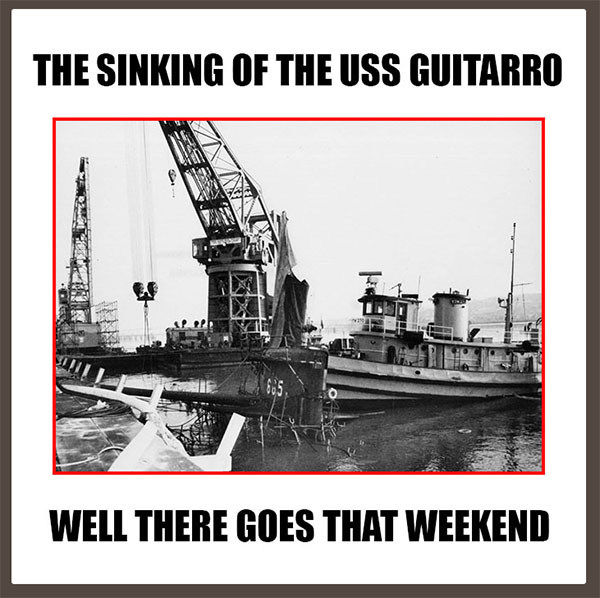
In the article, “The Sinking of the USS Guitarro – Well There Goes That Weekend” I discussed my role in the raising of the Guitarro. The story ended with me driving home after a 33-hour workday at the shipyard. On that Saturday afternoon I arrived home fully expecting not to go back to the shipyard until Monday morning. After taking a shower and getting something to eat I headed to bed about 8 P.M. Sunday was going to be a “sleep in late” day for me.
That was not to be. At 6:30 A.M the phone rang. It was the shipyard. I don’t remember who called but they said that the submarine was being raised and would be going into drydock #2. The dock blocks had to be reset, and this would be completed by midnight. He continued and said that someone had decided that more equipment on the boat could be saved if shipyard personnel filled critical compartments with fresh water immediately. Since this would change the configuration of the boat, a new set of stability calculations would be required before the ship could be moved into the drydock. They told me to come back to the shipyard.
So before 8 A.M. I was driving back to the shipyard.
When I arrived at the shipyard, I was surprised to learn that the shipyard had not been able to reach Bill, the Naval Architect that had directed my work the previous day. These were the days before cell phones and Bill did not carry a beeper. So, I was on my own.
Fortunately, these calculations were much simpler, and I could reuse some of the work from the previous day. So, everything went smoothly. I finished the calculations by 4 P.M. and notified the duty officer. I waited for someone to come to pick up the calculations and got ready to head home.
A Navy Captain arrived to pick up the calculations. It was the Shipyard Planning Officer, the highest-ranking officer in the Planning Department. I was about six layers below him in the organizational structure.
I was shocked when he said they expected to dock the ship at about midnight, and he wanted me to stick around and inspect the dock blocks as soon as the ship was in dock. I sure was not going to tell a senior Navy Captain “no” so I said, “YES SIR.”
This meant that I had to stick around the shipyard for another 8 hours but that was not the big problem. I had never inspected dock blocks before. I had never seen anyone inspect dock blocks and I had no idea what a dock block inspection was.
The good news was I had 8 hours to decide how I was going to do the job.
At midnight I was standing at drydock #2 watching the USS Guitarro being pulled into drydock. Sometime before 1 A.M. the water in the drydock had been pumped out. It was time for me to begin my inspection.
I started down a narrow set of stairs built into the side of the drydock. I was carrying a clip board — I thought a dock block inspector must carry a clipboard. When I got to the bottom of the dock, I discovered that after water is pumped from a drydock the bottom of the dock is coated with 2 to 3 inches of mud. Also, some fish don’t get pumped out, so a few fish were flopping in the mud.
Before stepping into the mud, I took a long look at the ship. It was sitting upright. I was pleased.
Then I stepped into the mud in my tennis shoes. I was about mid-ship. I walked to the hull and looked at a dock block. It appeared to be in good shape — not crushed. I slowly moved from block to block toward the bow of the ship looking at each block. At the bow I crossed to the opposite side of the ship. Surely a dock block inspector would check the port and starboard sides of the block setup. I then moved toward the stern of the ship doing the same thing.
Mission completed. I had done my first dock block inspection.
By 1:30 A.M. I was in my car and headed home — muddy and very happy my first dock block inspection was over.
Footnote:
In June 1970, I received my master’s degree in Naval Architecture from the University of California, Berkeley. For my thesis I developed a computer program that calculated dock block loading and stress on the hull of a ship going into drydock.
GIVE US YOUR FEEDBACK. CLICK ON “COMMENT” TO TELL US WHAT YOU THINK or use one of the alternative methods for providing feedback.
I pictured my grandmother’s house on George Gregg Street as the center of the orchard universe. In my growing-up years I had explored and discovered all the fruit tree treasures that neighbors had put in place, well, to be neighborly I suppose. I am unsure of the exact reason because some of the neighbors did not welcome me to their horn of plenty. I had to deal with those in a covert manner we might call ‘night crawling.’
Mrs Crain owned the house next door. She was one of the first subjects of my night crawling because in a word, she was stingy. My grandmother said “No, just frugal,” because my grandmother had no ill to say of anyone. That is, except for “Archibald the Noser,” the man who regularly came to our home to conduct lifestyle reviews which would decide her continued eligibility for Old Age Assistance. That small dole was her only income.
When she saw him approaching the house, her language tested her very Presbyterian fiber: “Oh my stars and little fishes! It’s that blamed Archibald! Run and put on your jeans with the ripped out knees and those old Roebuck tennis shoes,” she said. “And just stare at the floor if he asks you anything.” I understood that I must not look prosperous, so I always chose the yellow shirt with the frayed collar tips—the tips I had chewed on until bleached and disfigured by elongation. It worked. The check kept coming. Archibald must have been quite thrilled with our poverty.
Mrs Crain had a fig tree beside her bedroom window that in season, boasted many pails of the fruit. It was so prolific that legend said she had dismembered and buried her husband beneath it. It was his rotting self that provided the special fertilizer.
It was the darkest night of no moon. On all fours, I crept around the back of the double garage we shared with Mrs Crain. Her rosebushes, placed there as a kind of perfumed razor wire, pulled and tugged at my progress. Not to be deterred, I crawled on, suffering the wounds that were dues for the reward to come.
The fig tree was loaded. I removed a pillowcase from under my shirt and began stuffing it with all the fallen figs first, then the ones I could reach while on my knees. I dared not stand, because that would place me squarely in front of her bedroom window. The sack was feeling generously heavy and it was time to abandon greed and settle for what was a respectful haul.
I twisted the neck of the sack closed and raced to my secret treasure box. The summer before, I dug a rectangular hole in the graveled garage floor large enough to contain a small metal locker my Uncle SB had used in the Army. Brushing away the loose pebbles that concealed it from view, I raised the lid and placed the figs inside. I would ration them over the next week or so. I could easily eat a dozen or more of them per sitting, so none were wasted. They were delightful; their pepper-sized seeds a tiny bit crunchy to the palate. A fig is best raw, and even better stolen. It is beyond me why Newton wanted to ruin it with that gummy cake of his.
The Liston family on East Avenue had a trellis of black grapes in their backyard. They didn’t seem to want them, because most seasons the fruit just fell to the ground and became scrap for crows. The crows would digest the grapes and later excrete them like so much purple rain. I figured that in taking them, I was performing a valuable service to the many people who had to polish the horrid crow stains off their automobile rooftops and hoods.
A rule of stealing fruit is that it is not stealing if no one wanted it in the first place. Tell that to “Sluggo,” the boxer dog who guarded the trellis against poaching. From my thievery kit emerged an effective weapon: A raw weenie for a guard dog is good trade for his silence and a posterior free of gnashing teeth. After repeated weenies, I think Sluggo actually began to like me. His wagging tail and light whimpering defied the “Bad Dog” sign that hung on the Liston fence.
Economics soon crept in. I began to evaluate the cost of a weenie against the grape’s worth. The grapes were tiny—not much bigger than a nice English pea. They were a bit tart, and the stain from their juice was like neon. It was impossible to deny that they had passed my lips.
“Did you ask permission to take Mrs Liston’s grapes? My grandmother asked.
“Yes, I got permission,” I replied. I was thinking of Sluggo’s approval, not Mrs Liston’s, so it was not a lie. It didn’t matter anyway. The puny grapes eventually failed the barter rule. A plump hot dog weenie was simply too much to invest in a substandard grape.
Two blocks away was the Smitherman home. There, proudly lining the sidewalk gate were two stately black plum trees. When ripe, the plums had a blue-gray haze on them that when rubbed away, revealed a skin as shiny as coal. The plums were fat—close to the diameter of a Yo-Yo. I reasoned that plums were perhaps the perfection of God’s engineering. The ratio of meat to seed-size left all other fruit in envy. Peaches and apples were not even close.
Both Mr and Mrs Smitherman worked for the railroad shops, so their coming and going was as predictable as morning light. I often made my way to their gate in full daylight, filling a water pail with hand-selected ripe plums. The trees were majestic; remindful of the date-palm adornments to the gates of old Rome that I remembered from the movies.
One early Monday morning, I walked down to the Smitherman’s yard with my ready pail. I was shocked to find their iron gate chained and locked. Apparently my raids had been discovered. On Sunday I saw Mr Smiterman at church. With my best innocence, I approached him at the end of the service.
“Mr Smitherman, I noticed you have a really nice plum crop and wondered if I might have some of them for my school lunch sack.”
“You mean you want more of my plums?” I could have taken his remark lightly, not personally, but I knew I had been admonished. Guilt has a way of weeding out ambiguity, tying the tongue, and quivering the hands.
“All you have to do is ask, and I can make sure the gate is open,” he said, with what looked like the apparition of a smile trying to break through. “My plums are there for the asking, not the taking.” Oddly remindful of an encounter with Archibald the Noser, my eyes fell to the hardwood floor of the church foyer and I nodded my understanding without looking up. I never stole from him again.
Mr Pedison was the owner of a stately hotel called the Ginocchio. It sat by the train station, and was famous for its rail-heyday history and its trappings, especially its sweeping staircase of rare curly pine. Among its legends and tales, there was common talk that a tunnel extended from beneath Mr Pedison’s house over to the hotel. The story told how the tunnel was used to secretly move traded slaves to waiting boxcars in the dead of night. Most people said it was a far fetched rumor. In any case, the alleged activity pre-dated Mr. Pedison by two-thirds of a century. Even though fully absolved by the passage of time, he was always quick to debunk the slavery tale.
“Ginocchio and Pedison ancestors kept no slaves,” he said. Slave trading aside, I noticed that he never denied the existence of the tunnel nor explained its purpose.
In the back yard of his home, Mr Pedison cultivated pears, Elberta peaches, and green baking apples. Mr Pedison knew me well since I delivered his newspaper, and invited me to share his fruit to the extent my cravings led me. I figured his free fruit substituted for a newsboy tip. Since I did not have to steal, I took only sparing amounts. It’s odd how having permission diminishes one’s greed. I never knew why, but it was true that in a three-way match, the pears always fell to last place in gathering. I could easily skip pears altogether. They simply are bland and unappealing. Maybe it’s because the red wasps competed with me so hard for them, or that almost everyone’s yard had a pear tree.
By contrast, there is nothing more summery than a chilled peach, its crimson and yellow insides surrounded with juice so bountiful that it would run down one’s arms and drip at the elbows. The reward of such a delicacy outweighed the one inconvenience: Peaches have an ornery fuzz that somehow is magnetized to adhere to the wrinkles underneath a young man’s neck. There it digs in to sting and irritate until scrubbed away with a wet washcloth generously slathered with that fearsome Lava Soap.
Legitimate fruit such as Pedison’s bypassed the treasure chest and made its way directly into my grandmother’s kitchen, where it served as filling for her delicious fried pies. The fruit was cooked into a mush and then nested in a fold-over crust similar in shape to today’s taco. My job was to then pinch the edges of the crust dough at index-finger intervals—a sort of zipper to keep it closed for frying.
“Little fingers make the ideal pinch,” she always said. It was my special contribution to the task, and I felt honored when our pie won a blue ribbon at the East Texas Fair.
“I did the zippers,” I boasted to those that came by our table.
Life’s mysteries surely must include the pomegranate. Larry Allen’s grandmother had two of the curious bushes. They seemed to have little appeal, for I was invited to take all I wanted. A pomegranate is a fruit that was designed to have no predators. Like the dreaded cockroach, pomegranates survived the great asteroid destruction of the Earth. Its classification as a fruit defies understanding. The skin and pulp are not edible, and are shunned even by coon, deer, and squirrels. The shoe-peg corn-sized seeds clustered inside are surrounded with nothing more than a halo of meat—a filmy suggestion of fruit. There is no such thing as a pomegranate fried pie, or even pomegranate preserves. They have no worth as a sack lunch snack; it would take an entire recess to dissect one.
Considering the fruit’s nutritional lapse, I’m not sure it was an asteroid that killed the dinosaurs. In any case, I must treat such time wasters as pomegranates like orphans, because the growing season is too short for diversions.
I’m heading back for more of Mr Pedison’s peaches, fuzzy neck et al.
* * *
The author’s three collections of short stories, Tailwind, Odie Dodie, and Riders of the Seven Hills are available at all traditional booksellers. Copies signed by the author may be obtained by contacting him directly via pogo@shreve.net or by accessing his web page at: http://laddiemoore.blogspot.com/
Like it or loathe it, the impeachment trial of Donald J. Trump is an extraordinarily historical event.
Like him or loathe him, the American people are entitled to know the truth: Did the president break the law?
Unconventional. That’s a good descriptive word for the 45th. president. Other words and phrases that, in my mind, also fits this president include “reactionary,” “ignorant of history and how government works,” “cyber-bully,” “egomaniacal,” “whining crybaby” and “flimflam artist.”
None of those descriptive terms are impeachable offenses; abuse of power and obstruction of justice are.
What we are seeing and going to see in the Senate version of a poorly written soap opera is comedy posing as a drama.
When the curtain comes up on the 21st of January, 2020 on the impeachment trial, the world will be seeing a farce of a trial; it will be a trial in name only. What will be shown on the world stage will be a partisan morality play superimposed over a promise of fairness and transparency.
Without pertinent witnesses (and Hunter Biden has no direct knowledge of the charges against the president; that is a ridiculous GOP talking point), the proceedings will be a whitewash, pure and simple.
If Trump did nothing wrong, allow witnesses and order up pertinent documents. Without them, there is not a trial, just a waste of time and money.
Trump has already been found guilty; he has been impeached, a stigma that will never go away.
The GOP will only put an exclamation mark on his humiliation by continuing the coverup.
GIVE US YOUR FEEDBACK. CLICK ON “COMMENT” TO TELL US WHAT YOU THINK or use one of the alternative methods for providing feedback.
Nothing has changed in four years. This column written in January 2016.
What are we doing to each other?
The frustration and anger from the heartland about the unbridled corruption and blind hatred directed at any person expressing an opinion that does not follow the bootfalls of a certain political philosophy has emerged with a vengeance.
It is impossible to have a meaningful exchange of ideas when people re-spew venom and lies from mouth breathers whose paycheck is based on the degree and mass of heated rhetoric they can shovel.
Certain politicos are profession aginners, fear-mongers, and haters. The fact that so many folks are buying into the frustration and hate-word-filled diatribes scares me and creates an intense sense of doom for America and its citizens.
Educate yourself on the issues and then vote. Exercising your right to vote — after filtering out the self-righteous pabulum — is paramount if we ever hope to bridge the chasm that is dividing this country.
This is not about Obama and/or Trump., Republican values, Democratic values, about guns or religious difference or where a person is born.
This is about acknowledging that America is broken and working to fix the ills washing over its citizens. It is not about creating more problems and hatred.
This election is important, possibly the most important in its history since the last days of WWII.
Educate yourself in all the issues; research each candidate and stated position; reject the implausible and the mountain of impossible theoretical promises; turn off cable news programs and start thinking for yourself.
Then, vote. The future of the country –the future of its heart and soul — are at stake.
Don’t let billionaires buy your vote. Think. Study. Vote.
GIVE US YOUR FEEDBACK. CLICK ON “COMMENT” TO TELL US WHAT YOU THINK or use one of the alternative methods for providing feedback.
I recently shared an article on Facebook, “Robot Janitors Arrive At Walmart, Human Job Losses Likely To Follow.”
The article was posted about two months after my article, “The Robots Are Coming” was published on EastTexasExposed.com but I had not seen the article before.
I found the comments to my Facebook shared post very interesting. One-person said, “The Democratic policy at work.” Another person said, “That 15 dollars an hour Democrat plan is what this is.”
These two replies show a complete lack of understanding of the problem. What is most alarming is that in this country today the response to every problem is to blame the other political party?
Specifically, I was unaware that robotics is a Democratic policy. Also, the person that thinks the $15 minimum wage is what is causing this problem is even dumber than I thought they were.
I fear this country’s future is not bright. As the country does down the tube, people will be arguing about which party flushed the toilet.
Unites States of America – R.I.P.
For the record this is what the article said:
Robot Janitors Arrive At Walmart, Human Job Losses Likely To Follow
Jake Thomas — December 2018
Automation is coming for another retail job as Walmart prepares to unleash 360 autonomous floor-cleaning robots to its U.S. stores by January, according to NBC News.
Walmart made the announcement jointly with Brain Corp, which makes the artificial intelligence platform that runs the robotic cleaners, in a Monday release.
The world’s largest retailer has already put more than 100 machines to work, with the help of Brain OS. When the autonomous janitors are in action, they have yellow safety guards on both sides, detering any customers who might be tempted to hop on and take a ride while cleaning is in progress.
There’s a siren on top that lets people know with a subtle “beep beep” that it’s coming through to clean. But that’s not all it’s doing. Brain’s robots have sensors that allow it to collect information, which can be uploaded into a store’s cloud-based platform. For instance, as the robot cleans, it could collect data on which shelves are empty, according to one potential use case shared by a Walmart spokesperson.
The floor-scrubbing robot is not Walmart’s only automation: “A shelf-scanning robot being tested in 50 locations alerts a team when items are out of stock or incorrectly priced” and an “AI helper, Alphabot, quickly retrieves items in storage to help fill online orders.”
Company leadership is convinced such technologies also help make human workers more productive, as employees can leave more menial jobs to robots and focus on “higher value” tasks.
“Brain OS is a powerful tool in helping our associates complete repetitive tasks so they can focus on other tasks within role and spend more time serving customers,” said John Crecelius, vice president of Central Operations at Walmart.
Though it is still unclear precisely how automation will impact human employment into the future, NBC noted that a McKinsey report issued in 2017 estimated about 400 million to 800 million jobs worldwide could be lost to automation by 2030.
GIVE US YOUR FEEDBACK. CLICK ON “COMMENT” TO TELL US WHAT YOU THINK or use one of the alternative methods for providing feedback.
By Ron Munden — ron@easttexasexposed.com — October 22,2018
Editor’s note: I wrote this story in October 2018. Since that time robotic has advanced as predicted. Sadly, 27 months has passed a our government has still not started to address this problem. Andrew Yang is the only person I have heard discuss the what we a facing.
Today there is lots of talk about 7000 immigrants from Central America walking through Mexico and headed to the U.S. border. People are afraid these people are coming to take our jobs. Fortunately, the President has promised to protect our jobs from these invaders.
I am confident that this nation will get through this event and it will have no significant impact on the citizens of this country.
These are not the invaders that concern me. The invaders that concern me will be coming by the millions and will have a major impact on American jobs. They will change society from what we have today.
The invaders that concerns me are ROBOTS. I fear that we are a nation that is not preparing for impact of the robot invasion.
For 20 years or so engineers and scientists working on artificial intelligence seemed to have been stuck and there was little progress being made. That has all changed in the last 5 years. AI is on the move again. Cheap sensors and other hardware are now available and computer power continues to increase at the rate predicted by Moore’s law. There is now the merging of these technologies and powerful but cheap robots are increasingly available. Over the next few years, millions of the robots will be entering the workplace in the United States. The same will be happening in other countries throughout the word. Millions of jobs will be lost to robots. Yes, there will be some new jobs created but for every job created hundreds of old jobs will be lost.
Foxconn is a company that makes iPhones for Apple in China. Last year Foxconn eliminated 60,000 positions and replaced these people with robots.
The President announced that Foxconn was going to build a new factory in the United States. Yes, this is good but don’t expect it to produce tens of thousands of factory jobs. It may produce a couple of thousand new jobs but most of them will be computer related jobs. The factory worker is going to quickly become extinct.
Job losses will not be limited to factory floor jobs. Many office functions can be accomplished by robots and computers, so the clerical field will shrink. Truck drivers will also go on the chopping block. The autonomous cars are just a few years away, but I predict that autonomous long-haul trucks will be on the road even quicker. The technology is simpler, and the cost savings are huge. All of this will happen because there are strong economic incentives. If a business owner hopes to stay in business, they will have to go to robots to remain cost competitive.
When this happens there will a world where there are much fewer jobs than there are people to fill those jobs and the world will face a paradigm shift. Unfortunately, I see no indication that the United States has begun planning for this change. What do you do with a massive number of people that do not have jobs? While the United States appears to be doing nothing, other countries have begun planning.
Last month China announced its intent to transition to a 32-hour work week. Their intent is to complete the transition in less than 10 years.
Change is imminent. If you think 7000 immigrants is the biggest problem we face, I think you are mistaken. More robots and fewer jobs will impact orders of magnitude more people that the immigrant problem. The sooner the government recognizes this the better off the American worker will be.
GIVE US YOUR FEEDBACK. CLICK ON “COMMENT” TO TELL US WHAT YOU THINK or use one of the alternative methods for providing feedback.
I grew up on Marshall Texas’ North Side, a reference to the neighborhoods north of Grand Avenue and beyond the Texas and Pacific Railroad tracks. People said our kind were poor and called us Northsiders. They said we were from the Shoebox Neighborhoods because our houses resembled uniform rows of sameness.
In contrast, Southsiders had the fairy-tale houses that dotted areas like Washington Place and Henley-Perry Drive. Here were quaint homes, chalets and bungalows having distinctly varied architecture and amenities that set them apart from the rest of the town. In Washington Place there were homes built entirely of rare petrified wood. Many had stucco alcoves with little statues and plaster carvings. Others had European-style roofs, some having clay tile and some with expensive faux-tile roofs made of metal. Mailboxes were forged of iron and had hand-painted ceramic insets depicting fox-hunting scenes. In the winter the owners decorated for Christmas with a flair that had the rest of Marshall driving past in caravans of awe. It was a storybook-like child’s eye version of a trip through Santa’s home town.
My visits to South Side were seldom, and not by invite. Our family didn’t mingle with Southsiders unless we needed to hire a lawyer or see a doctor. When we were flush with gasoline after payday, we often rode through their neighborhoods and hung our heads out the car window to try and breathe in the wealth. Packards and Cadillacs sat glistening in pea-gravel driveways. I didn’t see any Henry J’s like ours. In backyards I could see brick barbecue pits with forged metal hoods. To the side would be brightly-painted triple-swing sets with Jungle Jims. I bet the kids there shot Roman candles all year long.
North Side boys were late getting bicycles. We didn’t start with a small one and graduate through four or five sizes up to twenty-eight-inchers. We started with the twenty-eight-incher, always second-hand, and had to use a washtub as a step to mount it. For the next few years there would be no way to make it all the way up onto the seat. Burlap sacks wrapped around the top-tube and tied in place with a stocking had to do. Sometimes we had to add wooden blocks to the pedals to reach them. If we fell during our ride, we used curbs or stumps as assists to remount. If there were no curbs, we pushed the bike all the way back to the washtub.
Bikes aside, my favorite activity was climbing. I climbed everything. I sat on top of my garage until the red tin roof got too hot to manage through blue jean cutoffs. I walked the length of my house on the asphalt ridge cap like a circus high wire performer, arms spread out for balance and effect. I climbed the huge sweetgum tree and tossed its burrs toward a coffee can I had positioned on the storm sewer cover below. One point for each basket. At night, that same perch had me shooting burrs with a slingshot toward the Baptist College girls who passed beneath the streetlight. If one hit the mark, they cried out “Bats!” and fled screaming into the night.
At my uncle’s farm in Overton there was a working windmill. Its tail fin spelled the word ‘Aeromotor’ in faded letters. I could climb the cross braces as easy as I could a ladder. So could my uncle’s bird dog Wilbur, a skinny old farm hound that regularly joined me at the crow’s nest platform halfway up. He climbed down like he climbed up. His toes splayed out like a fan to steady himself on the metal angles. Sure footed as a goat, Wilbur was wasted in Overton. He could have easily made sway with John Ringling North.
I admit to having some climbing fears. Sometimes hackles of hair on the back of my neck would stiffen like those wild bristles on a used-up paintbrush. My palms revealed the same lingering cold sensation as when gripping the neck of a soda bottle to hoist it out of its ice cooler. Climbing meant placing one hand on the next rung or brace and keep moving. Rules emerged: Never stop, never ever look down.
The rest at the end of any climbing adventure was always interrupted by that dreaded fear of the trip back down. How did I actually get up here? Sometimes I would swear that some strategically-vital tree limbs had somehow been removed since I last used them. Climbing down was like having forgotten every good move, like being out of body. I would repeatedly swipe my palms down the legs of my jeans to dry them. One hand, then the other. Carefully position each foothold. Footholds on the way down were much more calculated than those of the brisk ascent. The last step was more of a leap, skipping one or two levels. The only means to quickly end the fear was to hasten that happy jolt when feet met earth.
Sometimes at night a group of other climbers joined me downtown to scale the rows of buildings like today’s Spiderman. There were streets where one building nearly touched another and we could traverse an entire block on rooftops. Pigeons scattered like gray apparitions against black canvas as we disturbed their rest. Oddly, we often found empty beer cans and bottles up there. We glanced around nervously. We weren’t the only visitors.
Nader’s Store had several rooftop skylights. Each had a pane that could be opened for emergency ventilation. I opened one, its rusty hinges squealing for oil. In the dimmed store lights I could see rows of shoes on display shelves far below. I dropped a handful of roof gravel down the vent for the discomfort of those trying on shoes tomorrow. I wondered what Nader must have thought. I bet he wrote the shoe company a letter.
Sam Houston School had a metal fire escape that was a chute with a section of covered tunnel stretching down several stories. I climbed it backwards many times on weekends just for the joy of a wax-papered ride back down.
Of all climbs, the cone-topped water tower known simply as The Standpipe was the cosmos of all fear and danger. To fall would be to careen off the hill into the pit that Marshall Pottery used as a dump for sharp pieces of broken pots. Standpipe therefore stood as did Everest, a magnet to the dauntless climber, knowing that such a fall would add severed arms and legs to mere broken bones. But many had done it before me. “MHS Seniors ’55” and “I Love Carol” were emblazoned on the tank’s sides along with the initials of many heroic conquerors. The city water department didn’t even clean the writing off. Standpipe legend was allowed to advertise.
Standpipe must be scaled at night to maximize both drama and covert act. Even so, it would not be uncommon for the odd patrol car to come by, dobbing its spotlight on the tower frame and catwalk. My friend Troy would stay below both as watchman and cheerleader. He was also assigned to remove the body if called upon.
I began my climb with a kiss planted on the tower’s massive outlet pipe, a climber’s bid for good luck. I had a can of spray paint tied to my belt. I chose red, the high school color. I had bought the paint two weeks earlier, fearing that the hardware store man would alert the police to such a purchase and Standpipe would be placed on a prolonged stakeout. The News Messenger headline would read: “Alert Clerk Foils Latest Standpipe Attempt. Climber Sent to Reform School.”
Seven or eight feet into the climb, one had to navigate a barbed-wire barrier installed to deter the weak and easily discouraged. The wires had been spread apart enough times that they had become spacious and I easily passed between them. Troy gave me my first cheer but I didn’t look down. The ladder welds had broken in a few places and the sides quivered more than I liked. In a few spots it wobbled enough to clank, triggering a “Shhh!” from Troy below.
I brushed away a bird’s nest and dirt and debris fell on my face and into my eyes. I locked my leg through the back side of the rung and clamped the toe of my shoe on the next rung below. That move allowed me the necessary comfort and insurance to free one arm and wipe my eyes on my sleeve. I blinked over and over. Irritant tears began to well and eventually a muddy stream stained my face.
Soon I reached the pinnacle; a catwalk that encircled the tank like a metal garter belt. I crawled from the access hole onto the flat surface and lay still. I could see Troy sitting on the grass with his flashlight illuminating his face. He said something I couldn’t understand. I continued to lie there and catch my breath. My chest heaved up and down enough that it felt like pushups. I turned onto my side. Gripping the braces on the catwalk, I slowly stood upright. My fingers clung to the rail as though fused to the metal.
A twinkling panorama stretched out before me. I let go the rail long enough to wipe my eyes with my shirttail, removing the last of the bird’s nest. To the south I could see a bright red haze. It was the glow of the rooftop neon letters spelling Hotel Marshall. In the distance to both the left and right blinked twin radio towers. One was KMHT. The other one? Maybe Wiley College had a station. The towers’ red pulses were ironically timed to the pace of my breathing. At the ten o’clock position I could see the alternating green and white waves of the Marshall Airport beacon. Directly in front I could make out the shiny dome of the old courthouse. Farther right at four o’clock was a cluster of lights knitted closely together. Baptist College?
Above me unfurled a mosquito net of stars, brighter than any other time I had looked into the heavens. Was I just closer to them? While looking up I saw a blank spot on the tank’s east side. As high as I could reach I painted my initials there, followed by the date. Then I noticed something curious. Some of the painting was well above mine, reminding me of six-foot-four Raymond Craig. Raymond played varsity basketball and could hurl himself off the rim like Tarzan from a vine. Even Ray couldn’t reach that far up. It had to mean just one thing. Certain others before me had stood on top of the catwalk handrail to paint! I regretted having already put my mark there; others might see mine as less legitimate. I contemplated a re-do but only briefly. A return of neck hair like a Mohawk and palms like ice blocks quickly tamed my zeal. To seal this welcome rush of good sense, I let the can of paint fall to the ground.
“Dang! You dropped your paint,” said Troy. “No way can I throw it up that far.” “Deed is already done,” I said. Another cheer from Troy.
I made my way back to the firm red clay. My legs were trembling like I imagined an earthquake might cause. I felt weak all over. Not from the climb, but from an ebb of fear flowing out of me.
The next day Troy and I rode over to Standpipe. I felt the chills of pride and opened a wide smile meant solely for me. My initials were more prominent than I had hoped. Troy beamed at me like I was a brother just home from the war. It was a look that mixed awe with respect.
Our neighborhood slowly changed. First the T&P railroad shops were razed. Then the old East Avenue Viaduct was toppled by an over-height railcar crane and never rebuilt. The Standpipe Tower outlasted almost everything until a few years ago when the city tore it down for no reason whatsoever.
The destruction of Standpipe removed yet another monument to the legitimacy and honor of North Side. There are damn few left.
* * *
The author’s three collections of short stories, Tailwind, Odie Dodie, and Riders of the Seven Hills are available at all traditional booksellers. Copies signed by the author may be obtained by contacting him directly via pogo@shreve.net or by accessing his web page at: http://laddiemoore.blogspot.com/
A decades-old survey by the psychology department of a prestigious university concluded that an overwhelmingly large percentage of people have, at some point in their lives, wished they could swap places with someone else.
You know, swap life for life, even-up.
Most folks indicated they would change due to lifestyle. (“Being a movie star is so glamorous!” Or, “I’d love to be a major league baseball player!” Or, “I want to be that guy that won the lottery!”)
On the other side of that conversational coin are a swarm of people I would not want to be. That list is longer than the Nile River and is chuck full of people who I personally wish were not household names.
The short, I-am-throwing-up-in-my-mouth list includes (President Trump, most aides, all kids and all cabinet officials but one excluded for purposes of readability length):
— Rev. Al Sharpton: I do not want to be anyone who wakes up every morning thinking every issue can be boiled down to a black-white rant..
— Sean Hannity: Selling my soul every day for money is not my idea of “living the good life.” That, to me, would be existing in a living-dead environment.
— Duane Johnson, The Rock: I would be clueless about what to do or how to move with all those muscle bumps.
— Secretary of State Mike Pompeo: It must be hard to be an active participant in digging the hole in which your legacy as a public servant will be buried.
— Robert Redford: Seriously, if I were that handsome and suave at that age, I’d be really dangerous.
— Sen. Lindsey Graham: see “Mike Pompeo”.
— Alexandria Ocasio-Cortez, aka AOC: I would not want to be that young and be known by an acronym. That means you have done something incredible, something worthy of instant recognition. Being a political “saddle burr” or a constant ache requiring the services of a proctologist is not a qualifier for stand-alone, initialed status.
— Any so-called “femebrity” or “himebrity” who is famous for nothing other than showing off certain body parts on social media … again and again and again.
— Any person so vain that they resort to multiple plastic surgeries to stay “young,” thus telling the world they do not believe in the law of gravity or that they don’t mind their face looking like that of a ventriloquist’s dummy. (Wait! Does putting a dab of Preparation H under your eyes to dawn up the extra skin count? If so…guilty.)
Bottomline: I like being me, growing older at a rate God intended. And, I am happy in my life, which, counting from conception in Seattle in September 1944, right before my dad was shipped to the Pacific front during Wold War II, has entered its fourth quarter-century.
Every day I find reason to laugh and rejoice in the daily ritual of living. Married to the first woman I ever thought about marrying more than 55 years ago, each day together is a joy-filled celebration of life, love and laughter.
With all those blessings, why would I ever want to change places with anyone? And, just being happy being me doesn’t wear me out. At my age, that is a plus.
GIVE US YOUR FEEDBACK. CLICK ON “COMMENT” TO TELL US WHAT YOU THINK or use one of the alternative methods for providing feedback.
While news of the extinction of another species is always sad, there is a positive side to the story here in the Deep South – With the announcement that the Chinese Paddlefish is now extinct https://www.cnn.com/2020/01/07/asia/chinese-paddlefish-extinct-study-intl-hnk-scli/index.html, the American Paddlefish, is now the only remaining species out of 6 previously existing https://caddolakeinstitute.org/paddlefish/. The Paddlefish is North America’s oldest living species, 50 million years older than the dinosaurs. Though they are alive and well in many U.S. rivers, they had been extirpated from Caddo Lake/Big Cypress Bayou (on the border of Louisiana and Texas.) https://www.youtube.com/watch?v=U4WSXXzjnbg (rights free package.) Historic agreements with the Corps of Engineers and a broad coalition of supporters is restocking them.
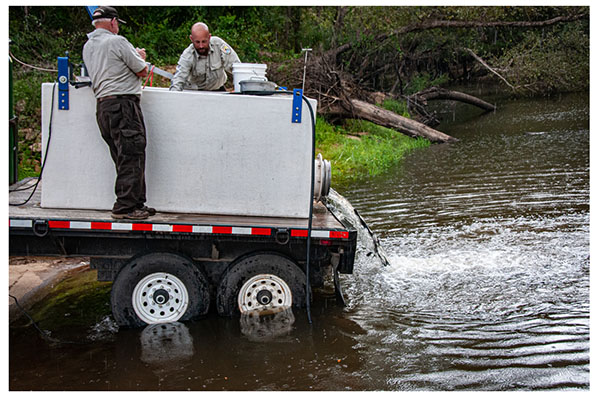
The U.S. Fish Wildlife Service, along with Texas Parks and Wildlife and Louisiana Department of Wildlife and Fisheries, embarked on a 10 year full-scale restocking of Paddlefish back into Caddo Lake in 2018. This is only possible because habitat has been restored through an historic agreement that balances the needs of industry and municipalities with the environment.
In 2005, the Caddo Lake Institute, with many key nonprofit and government partners, began working on a flows regime that would help restore habitat and fisheries in Big Cypress Bayou/Caddo Lake. One key native species, the Paddlefish, had disappeared from Caddo after loss of springtime pulses indicating it was time to spawn, and lack of rocky bottoms on which to lay their eggs. The flows project remedied those issues, providing springtime pulses and sediment scouring. The USACE placed gravel spawning shoals in Big Cypress Bayou which remain clear of sediment. Experimental releases of paddlefish begun in 2014, were successful and in 2018 a full scale restocking of Paddlefish was begun and will continue until a viable population can be established. These fish are 350 million years old, older than the dinosaurs, are filter feeders, have no scales and essentially no bones. They are listed as threatened in the state of Texas and are not game fish. Game fish restocking occurs regularly in Caddo.





 iEXPOSED.us Blog
