Iowa. Dead. Not the entire state, but the status of the nation’s first presidential primary is dead.
It was killed by technology … and the lack of it, and a failure to recognize the need for change and the refusal to do anything to implement that change in a reasonable and timely manner.
The elementary school line-up-for- recess exercise called the Iowa Caucus was, well, endearing and quaint and…, yes, antiquated. But, golly gosh, it was the first presidential primary and the candidates and media focused attention on the small Out There state for months and it made everyone interested in politics simply giddy in anticipation.
But Iowa blew it in such a demoralizing, rural-cousin l, embarrassing sort of way that another, more sophisticated state will get bumped to the top of the presidential primary pecking order in 2024.
As of early Tuesday, a Democratic winner in the Iowa Caucus had not been announced. Virtual all candidates or their campaign staffs had harsh words for the state Democratic Party and its decision to use a reporting app for results. The Peter Principle, of course, went into effect, with the app failing; the back-up plan — calling in precinct results as has been done in the past — failed as the phone system could not handle the traffic overload.
Result: Chaos,m, andmad campaign workers, delegates and the horde of media encamped in the state to report results.
Bottonline: In the wake of this take-no-prisoners scene from “Lord of the Flies,” if Iowa schedules a caucus in 2024, it will be without the blessing of the National Democratic Committee.
It is no secret that the catch-as-catch-can-line-up-under-the-sign-of-your-preferred-candidate voting process in Iowa’s 1,681 precincts was…maybe, cute.
But cute, in this era of technological supremacy and instant media reporting, is passe’ and tradition will no longer be good enough to sustain the privileged position of being the harbinger for the presidential political season.
The caucus circus has always been fun: Friends meeting friends, sizing up the size of the crowds at all the candidates’ designated meeting areas, ordinary citizens laughing it up with reporters and jockeying for their 15 seconds of fame.
Now, all gone.
Gone because a small state chose to act small rather than act smart.
It was fun while it lasted. Iowa, As the song lyrics go:
“So long, it’s been good to know ya
So long, it’s been good to know ya
So long, it’s been good to know ya
What a long time since I’ve been home
And I’ve gotta be driftin’ along”
GIVE US YOUR FEEDBACK. CLICK ON “COMMENT” TO TELL US WHAT YOU THINK or use one of the alternative methods for providing feedback.
We were a tight group, huddled together by like circumstance. We all worked for a manufacturer of fiberglass canoes at a plant near Austin’s Lake Travis. Our employer made the decision to open a smaller branch manufacturing plant in Carthage, Texas. Four of us were picked to do the start-up, each bringing a particular expertise to the new location. There was Hal, who would run materials supply and the maintenance shop, James the Customer Service and Inside Sales Manager, and Jack the Accountant/Data Manager. I oversaw the forming molds and gel-coat Finishing Operations.
I respected them all, but especially Jack. More than once he displayed his command of the company books, often pulling long hours to close out month-end results. He was classic stereotype accountant; bespectacled, plastic pocket protector, and an annoying practice of using a jumbo paper clip as a necktie clasp. His appearance may have been comedic, but his prowess with numbers was without equal. The crew lovingly referred to his ability to polish financial statements as “Jack’s Magic-Bean Counting.” He could walk the accounting tightrope without a net, knowing exactly how to win without cheating.
In the tradition of the old barn-raisings of the colonial past, all of us showed up to help one another when the moving vans arrived. Like a colony of ants, we unpacked boxes, set up furniture, and put the new household together in a fury of muscle power. It was both a ritual of welcoming and sharing, and a good reason to break out a cooler of beer when the task was over.
Jack’s arrival was no different. All of us were there to greet the van. His was a full load, owing to the fact that Jack’s wife Mollie was an interior decorator. The house was filled with period pieces of museum quality and accessories handpicked from her buying trips. While we unloaded and unpacked, Jack busied himself with handyman chores. It was truly out of character to see Jack with tools in his hand. He didn’t fit the image of someone who knew a bolt from a screw. But there he was, wearing a nail apron filled with the essentials—hammer, screwdrivers, wrenches, and the like.
On a trip through the kitchen, I saw Jack on the floor, half his body hidden under the kitchen sink counter.
“What’s up?” I asked. I could hear some clanking of tools, and Jack uttering some fourletter words.
“Icemaker,” he muttered. “There’s no connection pipe down here. I’m going to have to tap into the cold water line and put in a valve.”
“Maybe you need Hal,” I offered, thinking to myself that this was more of a job for someone with maintenance skills.
“Nope, doing just fine,” he said, “Just save a cold beer for me. We’re gonna be able to freshen that chest with some new ice real soon.”
The crew went on with its work. Several times we passed through the kitchen, noting that Jack’s jeans had slipped down to the point that his rear end was all smile. It was shiny with sweat.
We were finished. Mollie unpacked some Ritz crackers and a jar of cheese spread, and the crew assembled in the den to attack the beer cooler. The early arrivals got the chairs and the rest of us sat on the fireplace hearth. The sofa was piled high with lampshade boxes.
Jack joined us, wiping his brow with his sleeve. “Ice real soon,” he announced.
Hal wanted the technical details. “What sort of valve was that you put on?”
“One of those clamp-on kinds; you know, it has a spike that pierces the pipe as you tighten it up. I tied it in on 3/8-inch copper.”
“3/8-inch copper on a water line?” Hal asked. “That’s odd, water lines are normally halfinch.
“3/8” said Jack, “3/8 valve with a rubber gasket. It’s not leaking a drop.”
One of the guys wanted to watch a NASCAR race, so we connected the TV at the most convenient cable outlet. Maybe an hour and two six-packs passed before IT happened.
In a mighty explosion, the house shuddered on its foundation. A tremendous fireball shot out across the back yard, and dense black smoke poured out of the kitchen into the den. But as abruptly as it blew, it was over. There was no lingering fire or aftershock. Hal and I stuck our heads around the corner of the den. The refrigerator and part of the kitchen wall lay in the back yard, and the freezer door was missing altogether. Inside, the kitchen wallpaper and curtains were crispy black. A gentle breeze from outside rippled through the charred opening.
The rest of the crew came into the kitchen, all wondering what had happened, yet happy that no one was even slightly injured. Molly’s mouth dropped open when she saw her prized Jenn-Air lying warped and crumpled in the azalea bed.
Hal did the investigation. Given the path of destruction, it seemed likely that the explosion came from behind the refrigerator. A dangling icemaker line was all that remained of that section of the wall. Under the sink, Hal was closing a valve with a wrench. In so doing, he made the discovery:
“Jack,” he said, “3/8-inch is usually natural gas, not water. You tapped into the cook-top burner line. The freezer compartment got packed with gas, and the icemaker motor provided the spark.”
Among the crowd in the kitchen, widening grins began to replace concerned frowns. Jack’s face was as red as the remaining azaleas.
Jack made us promise never to tell this story. I said I wouldn’t.
I lied.
* * *
The author’s three collections of short stories, Tailwind, Odie Dodie, and Riders of the Seven Hills are available at all traditional booksellers. Copies signed by the author may be obtained by contacting him directly via pogo@shreve.net
“Trump allies are handing out cash to black voters”
Story: “Organizers have begun holding events in black communities where they lavish praise on the president while handing out thousands of dollars in giveaways.
“Allies of Donald Trump have begun holding events in black communities where organizers lavish praise on the president as they hand out tens of thousands of dollars to lucky attendees.
“The first giveaway took place last month in Cleveland, where recipients whose winning tickets were drawn from a bin landed cash gifts in increments of several hundred dollars, stuffed into envelopes. A second giveaway scheduled for this month in Virginia has been postponed, and more are said to be in the works.”
Summary: the GOP is categorizing black voters as a group of Americans who will violate ethical principles and sell their vote for a few dollars,
Shame! Shame! Shame!
Ending comment on the legality of buying votes::
Whoever makes or offers to make an expenditure to any person, either to vote or withhold his vote, or to vote for or against any candidate; and
Whoever solicits, accepts, or receives any such expenditure in consideration of his vote or the withholding of his vote—
Shall be fined under this title or imprisoned not more than one year, or both; and if the violation was willful, shall be fined under this title or imprisoned not more than two years, or both.
Is there no end to the corruption?
GIVE US YOUR FEEDBACK. CLICK ON “COMMENT” TO TELL US WHAT YOU THINK or use one of the alternative methods for providing feedback.
[Marshall, Texas, January 31, 2020] City Manager Mark Rohr, on the City’s behalf, announces multiple positive steps forward on the new Animal Adoption Center.
In August, the City of Marshall City Commission voted to hire Shelter Planners of America. With due diligence, Shelter Planners of America have developed the Request for Qualifications (RFQ) and Request for Proposal (RFP) on the new Adoption Center through a design/build process. The RFQ and RFP are pending distribution awaiting the selection of a building site.
With the pledge of $900,000 by the Marshall City Commission and $250,000 by Harrison County Commissioners Court in 2019, the City has worked diligently to develop the outline for a holistic approach to animal policies for the City of Marshall. Experts agree that a new Animal Adoption Center is not the only answer to animal overpopulation. The City of Marshall has an outline for robust programs for spaying and neutering, microchips, rabies vaccinations and leash laws ready for implementation. The policies will be presented and discussed later in the year, but should be in place when the new Adoption Center opens.
In February of 2019, City Manager Mark Rohr initiated conversations with the leaders of the city’s larger organizations to grow the City of Marshall through active discussion of common goals. This group has become known as the Synergy Group. They meet monthly to brainstorm strategies to benefit our community and to coordinate efforts. One strategy borne from the Synergy Group was a plan for the City of Marshall and Marshall Independent School District to partner as taxing authorities on the location of the new Adoption Center. Through this partnership, the students of Marshall ISD will have extensive opportunities in the Career Technology Education (CTE) programs, FFA programs, and other enrichment activities during their educational experience.
The Adoption Center location is not specified at this time.
“It’s always motivating to see opportunities when Marshall Independent School District can collaborate with the City of Marshall, Harrison County, and other community stakeholders to augment the educational activities for our students. This partnership on a progressive Animal Adoption Center is another chance for our students to see responsibility today and a possible career in their future,” shared Dr. Jerry Gibson, Superintendent of Marshall Independent School District.
Marshall City Manager Mark Rohr stated, “This Adoption Center project is taking shape quickly. I am pleased with our recent progress. Pinpointing the location for the new facility is the next step in the process, which will trigger the remainder of the project. I hope to present this location in the very near future.”
GIVE US YOUR FEEDBACK. CLICK ON “COMMENT” TO TELL US WHAT YOU THINK or use one of the alternative methods for providing feedback.
On this day, there were multiple deaths reported, some expected, some that were surprises and one death that affected every American and resident in the United States.
The deaths included:
– Truth. Truth died at the hands of partisan politicians, callous cultists who calculated the odds of staying in a position of power versus declaring to the literary tomes of political history that truth matters and that the absolute truth is that, in the United States, no one is above the law. Truth died a horrible screaming death in the marbled Senate sanctum at the hands of elected officials who refused to expand the impeachment trial timeframe in order to keep truth a chance to once again breath.
— Separation of powers and justice: The constitutional divide between the executive and legislative branches of government was slowly strangled in the days of drama played out in the senate. That slow and painful death of justice was caused by the noose of neglect and negativism perpetuated by President Donald J. Trump and his disgruntled band of pompous head-nodders. In no other judicial case in history has a defendant directed the actions of the jury sitting in judgment. Trump and his automatons march in lockstep because of a conjoined belief that if the president is adjudged a liar, crook, extortioner and/or using the power of the presidency for personal gain, the voters will take out their frustrations on all things Republican.
Power, position, turf, territory, title and ego reign supreme in the hearts and minds of these petty elected officials, who put party over country and self-interest over everything other entity.
— Republican Party. The party of Lincoln and Reagan is no more. The death of the party that made an entire race free, that brought a divided nation back together and that created the policy of compassionate conservatism died this date from deliberate suffocation.
The party that for generations promoted free trade, small government and a balanced budget is smashed-skunk-in-the-middle-of-the-road dead. And, that nodule of conservatism will never be viable again.
The U. S. still has two main political parties: The Democratic Party and the Trumpian Party. Those former Republicans had choose not to sign on as a full-fledged Trumpians can only look in the mirror to see the reason this country is so divided; they can know the image staring back at them helped elect and support a dictator-in-waiting, and were an instrument of destruction for a once-great political institution.
There are few easy deaths, even fewer gallant ones. These deaths on the last day of January 2029 are particularly difficult, gruesome even, because they adversely affect every single resident of this nation…and the world.
If there ever will be a R.I.P., it will be a long time coming. Until that time, God bless us all.
GIVE US YOUR FEEDBACK. CLICK ON “COMMENT” TO TELL US WHAT YOU THINK or use one of the alternative methods for providing feedback.
I should have kept my Tupperware glasses, even though they were dishwasher-warped and the kids had chewed up the rims—turning the rims into a sort of dental floss.
* * *
By Lad Moore
Last July I broke a water glass on the kitchen floor. It was one of my favorites because it only held six ounces—I am not into the eighty-ounces-a-day horror. It was also the kind of glass that explodes and scatters on impact, like summer rain on the freshly waxed hood of a car. Pieces scampered to the safety of the braided rug, and raced for the darkness under the dishwasher vent-thing. More agile fragments mounted dust-bunnies and rode them out of the room.
I swept the kitchen, applying the principle of the grid-pattern that was developed for archeological digs. Then I wet-mopped—making sure the infected sponge head was hermetically bagged and tossed. Lastly, I vacuumed the entire floor with the latest superhuman Oreck technology—you know, the $1000 vacuum cleaner that can suck Orville Redenbacher through a garden hose.
But woe, on Sunday I located that last lone sniper of a sliver with the naked heel of my foot. I was always afraid it might be somewhere out there, despite the fact that the statute of orphaned glass shards had comfortably passed. And darn it, I had felt safe. After all, my dog Quigley had done reconnaissance for me when he padded over to his food bowl dozens of times without mishap.
I could feel the glass when I caressed the spot with a loving finger, but I couldn’t see or grasp it. Surgery was clearly indicated. Doctors lie when they say that pieces of glass will work themselves out. They only work themselves near.
I probed the spot with a needle until my self-inflicted wounds dwarfed the original injury. Multiple epithets ended the operation without confirming if success had been achieved.
It is now February. The spot of my summer surgery has hardened into a kernel that is resistant to even the most aggressive of emery boards. And it is always first in line to complain that my newest shoes should have been a half-size larger.
* * *
The author’s three collections of short stories, Tailwind, Odie Dodie, and Riders of the Seven Hills are available at all traditional booksellers. Copies signed by the author may be obtained by contacting him directly via pogo@shreve.net or at his web page at: http://laddiemoore.blogspot.com/
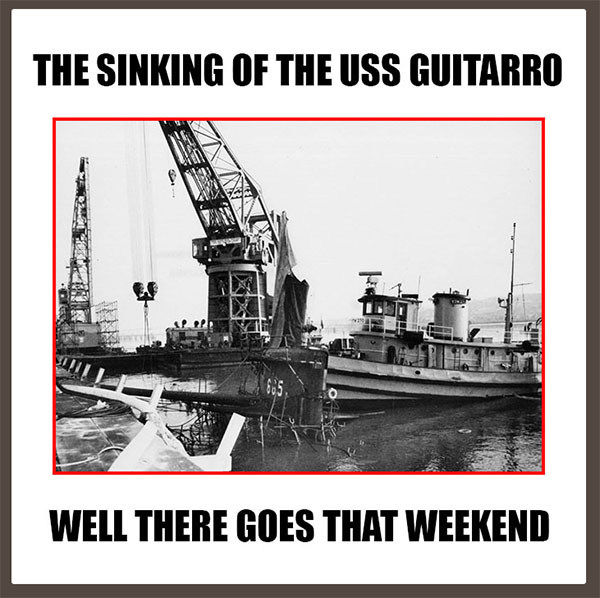
In the article, “The Sinking of the USS Guitarro – Well There Goes That Weekend” I discussed my role in the raising of the Guitarro. The story ended with me driving home after a 33-hour workday at the shipyard. On that Saturday afternoon I arrived home fully expecting not to go back to the shipyard until Monday morning. After taking a shower and getting something to eat I headed to bed about 8 P.M. Sunday was going to be a “sleep in late” day for me.
That was not to be. At 6:30 A.M the phone rang. It was the shipyard. I don’t remember who called but they said that the submarine was being raised and would be going into drydock #2. The dock blocks had to be reset, and this would be completed by midnight. He continued and said that someone had decided that more equipment on the boat could be saved if shipyard personnel filled critical compartments with fresh water immediately. Since this would change the configuration of the boat, a new set of stability calculations would be required before the ship could be moved into the drydock. They told me to come back to the shipyard.
So before 8 A.M. I was driving back to the shipyard.
When I arrived at the shipyard, I was surprised to learn that the shipyard had not been able to reach Bill, the Naval Architect that had directed my work the previous day. These were the days before cell phones and Bill did not carry a beeper. So, I was on my own.
Fortunately, these calculations were much simpler, and I could reuse some of the work from the previous day. So, everything went smoothly. I finished the calculations by 4 P.M. and notified the duty officer. I waited for someone to come to pick up the calculations and got ready to head home.
A Navy Captain arrived to pick up the calculations. It was the Shipyard Planning Officer, the highest-ranking officer in the Planning Department. I was about six layers below him in the organizational structure.
I was shocked when he said they expected to dock the ship at about midnight, and he wanted me to stick around and inspect the dock blocks as soon as the ship was in dock. I sure was not going to tell a senior Navy Captain “no” so I said, “YES SIR.”
This meant that I had to stick around the shipyard for another 8 hours but that was not the big problem. I had never inspected dock blocks before. I had never seen anyone inspect dock blocks and I had no idea what a dock block inspection was.
The good news was I had 8 hours to decide how I was going to do the job.
At midnight I was standing at drydock #2 watching the USS Guitarro being pulled into drydock. Sometime before 1 A.M. the water in the drydock had been pumped out. It was time for me to begin my inspection.
I started down a narrow set of stairs built into the side of the drydock. I was carrying a clip board — I thought a dock block inspector must carry a clipboard. When I got to the bottom of the dock, I discovered that after water is pumped from a drydock the bottom of the dock is coated with 2 to 3 inches of mud. Also, some fish don’t get pumped out, so a few fish were flopping in the mud.
Before stepping into the mud, I took a long look at the ship. It was sitting upright. I was pleased.
Then I stepped into the mud in my tennis shoes. I was about mid-ship. I walked to the hull and looked at a dock block. It appeared to be in good shape — not crushed. I slowly moved from block to block toward the bow of the ship looking at each block. At the bow I crossed to the opposite side of the ship. Surely a dock block inspector would check the port and starboard sides of the block setup. I then moved toward the stern of the ship doing the same thing.
Mission completed. I had done my first dock block inspection.
By 1:30 A.M. I was in my car and headed home — muddy and very happy my first dock block inspection was over.
Footnote:
In June 1970, I received my master’s degree in Naval Architecture from the University of California, Berkeley. For my thesis I developed a computer program that calculated dock block loading and stress on the hull of a ship going into drydock.
GIVE US YOUR FEEDBACK. CLICK ON “COMMENT” TO TELL US WHAT YOU THINK or use one of the alternative methods for providing feedback.
I pictured my grandmother’s house on George Gregg Street as the center of the orchard universe. In my growing-up years I had explored and discovered all the fruit tree treasures that neighbors had put in place, well, to be neighborly I suppose. I am unsure of the exact reason because some of the neighbors did not welcome me to their horn of plenty. I had to deal with those in a covert manner we might call ‘night crawling.’
Mrs Crain owned the house next door. She was one of the first subjects of my night crawling because in a word, she was stingy. My grandmother said “No, just frugal,” because my grandmother had no ill to say of anyone. That is, except for “Archibald the Noser,” the man who regularly came to our home to conduct lifestyle reviews which would decide her continued eligibility for Old Age Assistance. That small dole was her only income.
When she saw him approaching the house, her language tested her very Presbyterian fiber: “Oh my stars and little fishes! It’s that blamed Archibald! Run and put on your jeans with the ripped out knees and those old Roebuck tennis shoes,” she said. “And just stare at the floor if he asks you anything.” I understood that I must not look prosperous, so I always chose the yellow shirt with the frayed collar tips—the tips I had chewed on until bleached and disfigured by elongation. It worked. The check kept coming. Archibald must have been quite thrilled with our poverty.
Mrs Crain had a fig tree beside her bedroom window that in season, boasted many pails of the fruit. It was so prolific that legend said she had dismembered and buried her husband beneath it. It was his rotting self that provided the special fertilizer.
It was the darkest night of no moon. On all fours, I crept around the back of the double garage we shared with Mrs Crain. Her rosebushes, placed there as a kind of perfumed razor wire, pulled and tugged at my progress. Not to be deterred, I crawled on, suffering the wounds that were dues for the reward to come.
The fig tree was loaded. I removed a pillowcase from under my shirt and began stuffing it with all the fallen figs first, then the ones I could reach while on my knees. I dared not stand, because that would place me squarely in front of her bedroom window. The sack was feeling generously heavy and it was time to abandon greed and settle for what was a respectful haul.
I twisted the neck of the sack closed and raced to my secret treasure box. The summer before, I dug a rectangular hole in the graveled garage floor large enough to contain a small metal locker my Uncle SB had used in the Army. Brushing away the loose pebbles that concealed it from view, I raised the lid and placed the figs inside. I would ration them over the next week or so. I could easily eat a dozen or more of them per sitting, so none were wasted. They were delightful; their pepper-sized seeds a tiny bit crunchy to the palate. A fig is best raw, and even better stolen. It is beyond me why Newton wanted to ruin it with that gummy cake of his.
The Liston family on East Avenue had a trellis of black grapes in their backyard. They didn’t seem to want them, because most seasons the fruit just fell to the ground and became scrap for crows. The crows would digest the grapes and later excrete them like so much purple rain. I figured that in taking them, I was performing a valuable service to the many people who had to polish the horrid crow stains off their automobile rooftops and hoods.
A rule of stealing fruit is that it is not stealing if no one wanted it in the first place. Tell that to “Sluggo,” the boxer dog who guarded the trellis against poaching. From my thievery kit emerged an effective weapon: A raw weenie for a guard dog is good trade for his silence and a posterior free of gnashing teeth. After repeated weenies, I think Sluggo actually began to like me. His wagging tail and light whimpering defied the “Bad Dog” sign that hung on the Liston fence.
Economics soon crept in. I began to evaluate the cost of a weenie against the grape’s worth. The grapes were tiny—not much bigger than a nice English pea. They were a bit tart, and the stain from their juice was like neon. It was impossible to deny that they had passed my lips.
“Did you ask permission to take Mrs Liston’s grapes? My grandmother asked.
“Yes, I got permission,” I replied. I was thinking of Sluggo’s approval, not Mrs Liston’s, so it was not a lie. It didn’t matter anyway. The puny grapes eventually failed the barter rule. A plump hot dog weenie was simply too much to invest in a substandard grape.
Two blocks away was the Smitherman home. There, proudly lining the sidewalk gate were two stately black plum trees. When ripe, the plums had a blue-gray haze on them that when rubbed away, revealed a skin as shiny as coal. The plums were fat—close to the diameter of a Yo-Yo. I reasoned that plums were perhaps the perfection of God’s engineering. The ratio of meat to seed-size left all other fruit in envy. Peaches and apples were not even close.
Both Mr and Mrs Smitherman worked for the railroad shops, so their coming and going was as predictable as morning light. I often made my way to their gate in full daylight, filling a water pail with hand-selected ripe plums. The trees were majestic; remindful of the date-palm adornments to the gates of old Rome that I remembered from the movies.
One early Monday morning, I walked down to the Smitherman’s yard with my ready pail. I was shocked to find their iron gate chained and locked. Apparently my raids had been discovered. On Sunday I saw Mr Smiterman at church. With my best innocence, I approached him at the end of the service.
“Mr Smitherman, I noticed you have a really nice plum crop and wondered if I might have some of them for my school lunch sack.”
“You mean you want more of my plums?” I could have taken his remark lightly, not personally, but I knew I had been admonished. Guilt has a way of weeding out ambiguity, tying the tongue, and quivering the hands.
“All you have to do is ask, and I can make sure the gate is open,” he said, with what looked like the apparition of a smile trying to break through. “My plums are there for the asking, not the taking.” Oddly remindful of an encounter with Archibald the Noser, my eyes fell to the hardwood floor of the church foyer and I nodded my understanding without looking up. I never stole from him again.
Mr Pedison was the owner of a stately hotel called the Ginocchio. It sat by the train station, and was famous for its rail-heyday history and its trappings, especially its sweeping staircase of rare curly pine. Among its legends and tales, there was common talk that a tunnel extended from beneath Mr Pedison’s house over to the hotel. The story told how the tunnel was used to secretly move traded slaves to waiting boxcars in the dead of night. Most people said it was a far fetched rumor. In any case, the alleged activity pre-dated Mr. Pedison by two-thirds of a century. Even though fully absolved by the passage of time, he was always quick to debunk the slavery tale.
“Ginocchio and Pedison ancestors kept no slaves,” he said. Slave trading aside, I noticed that he never denied the existence of the tunnel nor explained its purpose.
In the back yard of his home, Mr Pedison cultivated pears, Elberta peaches, and green baking apples. Mr Pedison knew me well since I delivered his newspaper, and invited me to share his fruit to the extent my cravings led me. I figured his free fruit substituted for a newsboy tip. Since I did not have to steal, I took only sparing amounts. It’s odd how having permission diminishes one’s greed. I never knew why, but it was true that in a three-way match, the pears always fell to last place in gathering. I could easily skip pears altogether. They simply are bland and unappealing. Maybe it’s because the red wasps competed with me so hard for them, or that almost everyone’s yard had a pear tree.
By contrast, there is nothing more summery than a chilled peach, its crimson and yellow insides surrounded with juice so bountiful that it would run down one’s arms and drip at the elbows. The reward of such a delicacy outweighed the one inconvenience: Peaches have an ornery fuzz that somehow is magnetized to adhere to the wrinkles underneath a young man’s neck. There it digs in to sting and irritate until scrubbed away with a wet washcloth generously slathered with that fearsome Lava Soap.
Legitimate fruit such as Pedison’s bypassed the treasure chest and made its way directly into my grandmother’s kitchen, where it served as filling for her delicious fried pies. The fruit was cooked into a mush and then nested in a fold-over crust similar in shape to today’s taco. My job was to then pinch the edges of the crust dough at index-finger intervals—a sort of zipper to keep it closed for frying.
“Little fingers make the ideal pinch,” she always said. It was my special contribution to the task, and I felt honored when our pie won a blue ribbon at the East Texas Fair.
“I did the zippers,” I boasted to those that came by our table.
Life’s mysteries surely must include the pomegranate. Larry Allen’s grandmother had two of the curious bushes. They seemed to have little appeal, for I was invited to take all I wanted. A pomegranate is a fruit that was designed to have no predators. Like the dreaded cockroach, pomegranates survived the great asteroid destruction of the Earth. Its classification as a fruit defies understanding. The skin and pulp are not edible, and are shunned even by coon, deer, and squirrels. The shoe-peg corn-sized seeds clustered inside are surrounded with nothing more than a halo of meat—a filmy suggestion of fruit. There is no such thing as a pomegranate fried pie, or even pomegranate preserves. They have no worth as a sack lunch snack; it would take an entire recess to dissect one.
Considering the fruit’s nutritional lapse, I’m not sure it was an asteroid that killed the dinosaurs. In any case, I must treat such time wasters as pomegranates like orphans, because the growing season is too short for diversions.
I’m heading back for more of Mr Pedison’s peaches, fuzzy neck et al.
* * *
The author’s three collections of short stories, Tailwind, Odie Dodie, and Riders of the Seven Hills are available at all traditional booksellers. Copies signed by the author may be obtained by contacting him directly via pogo@shreve.net or by accessing his web page at: http://laddiemoore.blogspot.com/
I recently shared an article on Facebook, “Robot Janitors Arrive At Walmart, Human Job Losses Likely To Follow.”
The article was posted about two months after my article, “The Robots Are Coming” was published on EastTexasExposed.com but I had not seen the article before.
I found the comments to my Facebook shared post very interesting. One-person said, “The Democratic policy at work.” Another person said, “That 15 dollars an hour Democrat plan is what this is.”
These two replies show a complete lack of understanding of the problem. What is most alarming is that in this country today the response to every problem is to blame the other political party?
Specifically, I was unaware that robotics is a Democratic policy. Also, the person that thinks the $15 minimum wage is what is causing this problem is even dumber than I thought they were.
I fear this country’s future is not bright. As the country does down the tube, people will be arguing about which party flushed the toilet.
Unites States of America – R.I.P.
For the record this is what the article said:
Robot Janitors Arrive At Walmart, Human Job Losses Likely To Follow
Jake Thomas — December 2018
Automation is coming for another retail job as Walmart prepares to unleash 360 autonomous floor-cleaning robots to its U.S. stores by January, according to NBC News.
Walmart made the announcement jointly with Brain Corp, which makes the artificial intelligence platform that runs the robotic cleaners, in a Monday release.
The world’s largest retailer has already put more than 100 machines to work, with the help of Brain OS. When the autonomous janitors are in action, they have yellow safety guards on both sides, detering any customers who might be tempted to hop on and take a ride while cleaning is in progress.
There’s a siren on top that lets people know with a subtle “beep beep” that it’s coming through to clean. But that’s not all it’s doing. Brain’s robots have sensors that allow it to collect information, which can be uploaded into a store’s cloud-based platform. For instance, as the robot cleans, it could collect data on which shelves are empty, according to one potential use case shared by a Walmart spokesperson.
The floor-scrubbing robot is not Walmart’s only automation: “A shelf-scanning robot being tested in 50 locations alerts a team when items are out of stock or incorrectly priced” and an “AI helper, Alphabot, quickly retrieves items in storage to help fill online orders.”
Company leadership is convinced such technologies also help make human workers more productive, as employees can leave more menial jobs to robots and focus on “higher value” tasks.
“Brain OS is a powerful tool in helping our associates complete repetitive tasks so they can focus on other tasks within role and spend more time serving customers,” said John Crecelius, vice president of Central Operations at Walmart.
Though it is still unclear precisely how automation will impact human employment into the future, NBC noted that a McKinsey report issued in 2017 estimated about 400 million to 800 million jobs worldwide could be lost to automation by 2030.
GIVE US YOUR FEEDBACK. CLICK ON “COMMENT” TO TELL US WHAT YOU THINK or use one of the alternative methods for providing feedback.








 iEXPOSED.us Blog
