AN UNCONVENTIONAL DEMOCRATIC CONVENTION: 1964

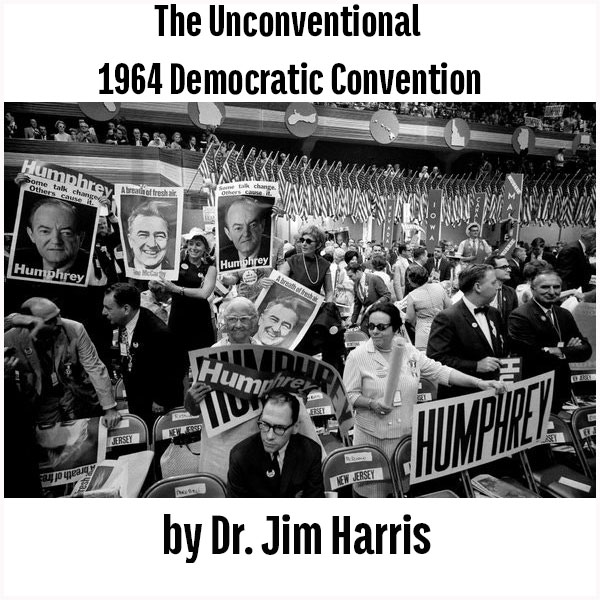
In August 1964, in Atlantic City, NJ, the National Democratic Party staged a presidential convention that, even for a political party in the midst of leadership and philosophical changes, was most unconventional. 

To a twenty-one-year-old medical student, the convention provided a close-up view of diverse and fascinating people and events, posed then on a convention hall stage, and remembered now on the stage of history.

My father was a pediatrician in Marshall, Texas; one his patients was the very sick child of Marvin Watson, the executive assistant to E. B. Germany, president of Lone Star Steel in nearby Daingerfield, Texas. The Watson child survived, and Watson formed a close and grateful friendship with my father. Both were also friends and supporters of Lady Bird and Lyndon Johnson. In fact, Watson had been doing various jobs for Johnson since they first met on the Baylor University campus in 1948.

When President John F. Kennedy was murdered in November 1963, Lyndon Johnson inherited a presidency and a bureaucracy staffed by men and women loyal to the late president and to his brother, Attorney General Robert F. Kennedy. These Kennedy supporters also ran The Democratic National Committee and had already selected Atlantic City, New Jersey, as the site of the 1964 Democratic National Convention.

Fortunately for Johnson, he sent Marvin Watson to Atlantic City to evaluate the preparations for this convention. In his book, Chief of Staff: Lyndon Johnson and His Presidency, Watson describes how in Atlantic City he found that Robert Kennedy and John Bailey, the head of the Democratic Nation Committee, had arranged to control completely the convention including the seating of delegates, the program, the speakers, the housing, and the social life. Watson discovered that Kennedy supporters planned to manipulate the convention in order to nominate Bobby Kennedy for president, rather than re-nominating President Johnson; and should they fail at securing the nomination for the presidency, they would then try to nominate Kennedy for vice president.

 When Watson reported the situation, President Johnson convinced Watson, who was not even on the government payroll at the time, to return to Atlantic City and to take over all of the preparations for the convention. Watson reorganized the convention over the next few months, and he must have made a favorable impression on the president, because in early 1965, Johnson made Watson his Chief of Staff at the White House, replacing Walter Jenkins whose star had fallen into a YMCA toilet.

 I was fortunate that one of Watson’s sons, Lee, a student at New Mexico Military Institute, was also involved in the page service. He would have made a good head of the page service because he knew everyone important. He had a natural and pleasant swagger as well as a wonderful personality, but he was only 18. Since I was 21, I was made head, but Lee and I became fast friends and split the leadership, the hours, and the headaches.

I don’t remember just how many pages we had, 10 perhaps, maybe more, and they were mostly little Yankee, city boys, many of whom were too young to be entrusted with the sensitive materials they were sometimes called upon to handle.

Watson or I manned the phones, and dispatched whichever page we had available to perform various tasks, comprised mostly of deliveries of materials and messages inside the convention hall. After a couple of days, we knew pretty much which boys we could trust. Thankfully, we had no responsibility for the pages after working hours. The best page we had was a mature and intelligent blond-headed boy from Dallas named Harlan Crow. He was about fifteen, I would guess, maybe a little younger. I tried to save him for the most important work, especially after one of the Kennedy Irish Mafia’s sons left some sensitive papers on a bench on the Boardwalk. I believe that boy’s name was O’Donnell. Fortunately, the papers were retrieved. As I recall, the papers were related to arrangements for President Johnson’s birthday party that was to be held in the ballroom at the convention center on August 28, the last night of the convention.

I might add that Harlan Crow came to my aid after that birthday party; our page service offices had been locked for security reasons, and I had an early flight to Dallas the next morning. I left in the office a $5.00 umbrella and a half-read copy of “On the Beach.” Crow somehow got the umbrella and book to me in Dallas after the convention. Only then did I find out that his father was the legendary developer, Trammel Crow. I haven’t seen Harlan since, but I understand he has done well in real estate himself.

One of my most poignant memories of the convention occurred when a fellow named Walter Cronkite taught me about scotch at a party a night or two before the convention opened. I was able to go to this and all of the parties during the convention due to an all-inclusive social pass that Lee Watson got me from a tall red headed boy from Texarkana whose dad was a wealthy donor. This boy had a pocket full of the top social passes available, given only to big donors and then based on the total amount of their contribution. Well, Lee Watson got us both a pass, which meant that we could go to any social event we wished. However, our other passes were even more important; after being investigated by the FBI prior to the convention, we were given security passes which cleared us to go ANYWHERE at the convention, and we did with our passes swinging like priceless jewelry around our necks. We would shut the page service down by about 6:00 PM. Then, we’d take off and look around, usually foraging for something to eat since our boarding house was a couple of miles away down the Boardwalk — too far to walk for a meal. I had been out of money for days, but at least I was able to afford hot dogs when my brother wired me some emergency cash. I ate 8-10 hot dogs each day while I was in Atlantic City. They were tasty, cheap, and ubiquitous, and, as I remember, still the best I’ve ever eaten.

The night I met Mr. Cronkite, I got to a cocktail party early. The occasion for the party was to celebrate the birthday of a Judge Tom Connally, a famous Texas politician and a distant relative of Gov. John Connally. I spied my favorite newsman sitting down on a window seat. I joined him in the window that was close to the bar. He was very nice to me — a gangly, young-looking nobody. He wore a blazer, slacks, and loafers with argyle socks pulled tight. When he found out that I was also a Texan, he taught me that scotch whiskey was a refined drink, more likely to reflect gentility and to prolong sobriety than the national drink of East Texas: bourbon and coke.

While waiting for the crowd to arrive, we had several drinks together. I was pleased to be the gofer. Mr. Cronkite was charming and entertaining, but I don’t remember what we talked about. I was surprised that we were left alone to talk for at least a half hour. Unconventionally, Cronkite was not the CBS Television anchorman that year as he was at every other national convention from 1952 until he retired in 1981. Cronkite’s demotion resulted from the ratings dominance of Huntley and Brinkley from NBC at the Republican Convention held in July, a month prior to the Democratic Convention. The CBS brass felt that Cronkite had suffered a bad convention, and he had worked alone. So, for the Democratic Convention, they replaced him with Roger Mudd and Robert Trout as co-anchors. Unfortunately for CBS, NBC beat them again in the ratings. Four years later, Cronkite was reinstalled as the Convention Anchor for CBS.

1964 marked the end of the New Deal coalition of democrats and resulted in the beginning of the movement of the conservative white Southerners (aka Dixiecrats) to the Republican party. This exodus was too late to help the Republican candidate, Senator Barry Goldwater, in 1964, but ultimately these conservatives fell into the waiting arms of Richard Nixon in 1968. Actually, Johnson had himself speculated that the Civil Rights Act of 1964, which he signed just before the convention, would likely cause this division to happen. After 1964, Texas and other southern states became true two-party states rather than states comprised only of democrats, be they liberal or conservative.

Additional party chaos was precipitated by events early in the summer of 1964, in Mississippi, under the leadership of the Council of Federated Organizations (COFO), a civil rights coalition comprised of the Nation Association for the Advancement of Colored People (NAACP), The Congress of Racial Equality (CORE), the Southern Christian Leadership Council (SCLC), and the Student Nonviolent Coordinating Committee (SNCC)) launched “Freedom Summer”, also known as the Mississippi Summer Project. The goal of the groups was to register as many Mississippi blacks to vote as possible. In addition, the Mississippi Freedom Delegation Party (MFDP) was formed. This was a political party composed mostly of blacks whose intent was to unseat the regular Mississippi delegation, largely made up by segregationists, at the 1964 Democratic Convention. The MFDP rode busses to Atlantic City and picketed the convention from the Boardwalk. There numbers were said to be in the thousands, but in Atlantic City, I only saw a few hundred of them at any one time.

Sadly, three of their members didn’t make the trip. Rather, Michael Schwerner and Andrew Goodman, both white boys from New York and James Chaney, a black civil rights worker were found rotting away in an earthen dam after being murdered on June 16, 1964, by Klu Klux Klan members, some of whom were law enforcement officials from Philadelphia, Mississippi. This brutal kidnapping and murder occurred just three days after the Civil Rights Act of 1964 passed the senate; President Johnson signed the act into law on July 2. The bodies of the three boys were discovered August 4, and the Johnson forces were fearful that massive picketing and violence might result at the convention.

Coincidently, I drove through Philadelphia, Mississippi the day after the bodies were found, but I didn’t stop in friendly Philadelphia.

The Johnson forces did not want any civil rights confrontations in general, and especially, they wanted no riots at the convention. The largely black MFDP requested and got a hearing by the Credentials Committee and asked that they be declared the official Mississippi delegation and to be seated in the hall rather than the segregationist delegation. Unconventionally, the hearing was considered important news and was televised nationally, on a quiet mid-afternoon, after the soap operas. The Page Service was also quiet, so I decided to attend the Credential Committee Hearing. I had time to figured out the likely areas on which the lone TV camera might dwell and sat there, hoping that my mother in Marshall, Texas, might see me and know that I was alive and well. She did.

By this time, having the run of the convention, I was pretty much taken with myself, and I wound up sitting is a box with folks who were due to testify that afternoon. One, a middle-aged man sitting to my left, ran out of cigarettes and started bumming from me. He looked familiar, and I realized that he was Mayor Richard Wagner of New York City. He was said to have vice presidential aspirations that did not come to fruition. It was hot in the room, and he had on a suit and tie and sweated considerably. I don’t recall that he ever testified.

I sat through the now famous testimony of Fannie Lou Hamer, a black woman who talked about the murder of Medgar Evers in 1963; she also described how she had been beaten when she tried to register to vote in Mississippi. I don’t remember much about her, but I do remember a tragic Jewish lady named Schwerner, the young widow of the dead civil rights worker whose body had just been uncovered in Mississippi. Her despair was palpable, and I hope never to forget her and her sad countenance.

The Johnson controlled Credentials Committee decided to let the convention decide which delegation to seat, and ultimately, a deal was made for the convention to seat two of the MFDP in the balcony. It has been speculated, apparently without documentation, that an agreement was made between the Johnson people and the MFDP that in exchange for accepting a minor convention role, that Hubert Humphrey would be the Vice-Presidential nominee. Humphrey, Walter Reuther, and several black civil rights leaders including Martin Luther King and Roy Wilkins were said to have worked out the compromise with the MFDP. Nevertheless, the rank and file of the MFDP was outraged at the perceived slighting of their delegation.

Two days later, at the onset of convention, all but three members of the regular Mississippi Delegation walked out after they refused to sign a loyalty oath to the Democratic Party. Many MFDP members had counterfeit tickets and gained entry into the hall anyway. Also, legitimate delegates from other states slipped the MFDP members extra passes to get onto the convention floor, where they milled around and then sat in the vacated seats of the authorized but absent Mississippi democrats. (The vacant seats were removed after that night.)

 Most of us at the convention were aware of the Mississippi problems, but after the televised hearing, the MFDP Party became old news, just as Watson and President Johnson hoped. Unconventionally, no roll call was ever performed at the1964 convention; Johnson was nominated by acclamation. Neither Mississippi delegation got to answer a roll call.

After the convention officially started on the night of August 24, it didn’t take me long to find that the best seats in the hall, when the convention was in session, were under the massive stage with its large podium at the front of the convention hall. This underneath, hidden space also housed the White House offices. There was a wide hallway with comfortable sofas and chairs along the right wall, with offices off to the left. Speakers waiting to go up to the podium, Secret Service men, various convention functionaries, Johnson cronies, and I hung out there at night.

 It was here that I met the nicest person that I remember from the convention: Phillip H. Hoff, the first Democratic governor from Vermont since 1854. Hoff was a handsome fellow with blond hair, a nice smile, an athletic build, and a nicotine habit. Cigarettes brought us together. He invariably ran out of cigarettes and smoked mine.

He was being groomed for national attention by the party, and accordingly, he had been requested to wait in the downstairs offices until he could be worked into the program for a short speech, at which time he would be seen by millions of TV viewers. Alas, apparently the time never got right for the Governor to speak, and he and I sat together under the stage nightly for three nights. We sat just inside the main entrance leading in from the convention hall, just across from the office of Walter Jenkins, then Johnson’s Chief of Staff. He had three television sets on his office wall that we could watch from where we were sitting if his door was open, as it usually was. Mr. Jenkins never said a word to the governor or me, but he did smile pleasantly at us more than once.

Hoff was nervous about having to speak in front of the convention, but he was a smart, friendly man. I started carrying two packs of cigarettes to the hall each night. If he ever figured out that I was a complete nobody, he never let on. He was never called to speak at the convention.

The Kennedy faction finally got a little TV time, on the last day of the convention. Robert Kennedy was to narrate a film about his brother. This film and other “Kennedy Day” activities had been moved by Marvin Watson to a terrible time slot—late at night and late in the convention—after both the President and the Vice President had been nominated. Thus, it was not possible for the convention to become overwhelmed by Kennedy and to put him on the ticket.

That night, Mr. Kennedy came to the door in the bowels of the convention center, and security and the official greeter let him in. Kennedy walked past all of us who were loitering there under the stage. Governor Hoff and I were in our usual seats, and various speakers and Johnson men were in the room. Kennedy was a small man, only a bit larger than tiny, but he walked directly through all of us, ramrod straight, looking neither to the left nor to the right. He didn’t smile; he didn’t say one word to anyone in the room. Without stopping, he climbed the stairs at the end of the hall and went onstage. Once introduced, he received twenty-two minutes of thunderous applause. When the crowd finally quieted, he made a short speech, and showed a film to honor of his dead brother. The speech and the film were well received by the convention.

Then Kennedy exited through the downstairs offices, again without a word to or glance at anyone. He had not one single confederate in the room. Kennedy was crying as he left. The convention that his folks had hoped to hijack was firmly in Johnson’s control, thanks to Marvin Watson. Shortly thereafter, his presidential aspirations squelched, Kennedy announced that he was going to run for the U.S. Senate from New York, as other carpetbaggers have been known to do since then.

Governor George Wallace made an appearance at the convention hall early in the week. He was a small man, well dressed, surrounded by large Alabama Highway Patrol agents. He pranced around like a little terrier for a few hours, and then I never saw him again. He had run well in some of the Democratic Primaries early in the year, but he had no real chance of securing the Vice-Presidential nomination. Ultimately, Wallace ran for President. He ran three times as a democrat and once as an independent without success. In 1972 he was paralyzed during an attempted assassination attempt.

When Wallace came in, the MFDP was picketing outside the main doors, and Peter Paul, and Mary, a famous and liberal folk singing group was holding court just inside the hall. The sun was shining, beautiful people were in and out, and the world seemed pretty right. Just out in the Atlantic was a Barry Goldwater sign that said: “In your Heart, you know he’s Right.” Someone had affixed a second sign to Goldwater’s that said: “Yes, Far Right”

One night during the convention, I got into one of the small elevators at the old convention building only to find Lady Bird Johnson and Frederick March, the famous actor, inside. Ironically, March, a well-known liberal, was at that time playing the President of the United States in the movie, “Seven Days in May.” I introduced myself to both and told Lady Bird that I was from Marshall. She grew up in nearby Karnack and had gone to high school in Marshall. She asked me if Dr. Harris, the Pediatrician, was my father, and when I replied that he was, she said, “Please give him my warmest and fondest personal regards.” He was later pleased at her greeting, and I was more than a little impressed that she remembered him. What a gracious and charming lady she was.

President Johnson became visible the last days of the convention. He was nominated for President on August 27, with Hubert Humphrey as his choice for Vice President. The following day, on his 56th birthday, the convention closed. Johnson later went on in the November general elections to score a victory by the then largest margin in history (61.2%) over Barry Goldwater and William E. Miller.

The Convention was one of the high points of my youth. Now, looking back, it seems strange that I never saw Billy Don Moyers, from Marshall. For a while, he was one of Johnson’s closest operatives and speechwriters. He was there. I just didn’t see him. Nor did I see the Johnson daughters, with whom my younger brother and I’d been paired for about 10 minutes at some political function in Marshall several years before. James Farmer, the founder of CORE, was also a former college student in and resident of Marshall, Texas, but I never saw him at the convention either. Wright Patman, Congressman from the First Congressional District of Texas from 1929-1976, a friend of my father’s and a devotee of my mother’s fried chicken, most likely was present, but I didn’t see him. It’s heady to say, but at a big convention, mere Congressmen didn’t amount to much in the pecking order. Finally, at the Convention, I never saw Senator Ralph Yarborough who had also been a Sunday guest at our home in Marshall, nor did I see Texas Governor John Connally.

 I saw President Johnson a couple of times at the convention, and a few months later, after the election, I saw him in Mt. Pleasant, Texas at a gathering at the local armory in honor of Marvin Watson, a man who that night Johnson described as “…as wise as my father, as gentle as my mother, as loyal and dedicated and as close to my side as Lady Bird.” Johnson had gone to considerable trouble to get to the function. He borrowed Governor Connally’s DC3 in order to land at the small local airport in bad weather as I recall.

I saw Mr. Johnson later at the football stadium at the University of Texas when we occupied urinals in close proximity under the watchful eye of the Secret Service.

The last time I saw President Johnson was the most memorable. He was in his casket. I was the physician in attendance at his burial at the graveyard on his ranch just north of Austin.

I was an Internist in the Army Medical Corp stationed at Darnall Army Hospital at Ft. Hood, Texas, in 1971-73. Periodically, consultants from Brook Army Medical Center in San Antonia, and other doctors from Austin who saw military and federal dependents would regale our doctors with stories about what a good guy but a terrible patient the retired president was. In a good-humored way, they revealed that the former president smoked, drank alcohol, and didn’t follow a diet. At any rate, his chosen lifestyle caught up with him and he died at his ranch at Stonewall, January 22, 1973. He was only 64 years old.

After funeral services in Washington D.C., at which Marvin Watson presented the eulogy, his body was flown back to Texas and bussed from Austin along with Billy Graham, the Joint Chiefs of Staff, the cabinet, about every legislator from Washington and Austin, and many of Johnson relatives to the family cemetery at Stonewall, on his ranch, which is now part of The Lyndon B. Johnson National Park.

My commanding officer at Ft. Hood (near Stonewall) knew of my connections with the Johnson family, so he had me take a MASH (portable) Hospital and the associated troops to the graveyard for the burial. Actually, all I really had to do was to show up. The real soldiers put up the hospital.

The weather was bitterly cold, and it was alternately raining and sleeting. It was a long walk from the parking area to the graveyard. I remember Senator Edward Kennedy with his wife who was beautiful but obviously ill as she tottered along in high-heeled shoes; she had trouble keeping up with her unsmiling husband as they walked in a long line of dignitaries down the narrow country road. At the graveyard, twenty or so friends and relatives, too old to make the walk, had already been seated inside the rock-walled cemetery. The old folks, and indeed, all of us, suffered mightily from the cold. The service was slow to start because of the size of the crowd and the long walk to the cemetery. Billy Graham preached too long for the weather, and John Connally talked too long as well.

Our large hospital tent, which housed a large stove, was just outside the cemetery. Periodically, mourners would slip into the tent to warm up. I went in only once to check things out, and I recognized Price Daniel Jr. who I knew from American Legion Boys State. His dad had been a Governor of Texas. At the time of the funeral, he was himself speaker of the Texas House of Representative. He and his wife were arguing loudly around the fireplace in the tent hospital.  I didn’t say hidey.

There was not enough room in the tent for all the old people to warm up, and I heard later that a couple of the mourners died of “the old man’s friend,” pneumonia.

The sleet got worse; I stood under a scraggly piece of a tree with a Secret Service agent. We were far enough away from the grave that we could visit a little bit. I had used my army uniform allotment to buy furniture, so I was clothed in my only dress uniform, a lightweight summer green uniform with a little dinky folding hat. The fancy army hat with the braid on the bill that, as a major, I was entitled to wear, was way out of my price range at about $50 used. I had on a $7.00 raincoat, but at least I had thought to put on a pair of long underwear. I should have put on two or three pairs. While I shivered intermittently in the midst of driving sleet, and while Billy Graham was speaking, the secret service agent looked over at me, fingered my shoddy raincoat, and shook his head dismissively. Then he said, “Doctor, you got to do better.”

In the years since, I have done some better, and after many years of medical practice and ranching, I am now retired with enough time for reflection about an unconventional but wonderful and exciting time in August 1964, and about a courageous president who has not been given adequate acclaim for the noble and far sighted legislation that he enacted.

And especially, I remember again with great fondness, a decent and loyal man who history should not forget—Mr. Marvin Watson.

GIVE US YOUR FEEDBACK.  CLICK ON “COMMENT” TO TELL US WHAT YOU THINK or use one of the alternative methods for providing feedback.


click here to CLOSE THIS PAGE

CURRENT IMMUNIZATION SCHEDULE FOR ADULTS

8/14/2020

I was recently advised by my Internist that I am in need a pertussis booster (whooping cough).  Furthermore, she said that we have had some local cases last year of whooping cough in adults whose childhood immunization has worn off for this disease. I am getting the shot and also re-educating myself about adult vaccinations. I will get tetanus/diphtheria/pertussis vaccination (called a “Tdap.” Naturally, I will repeat it every ten years.


The most inclusive web site that I found to “tone up” on vaccinations is that of the CDC. Texas also has a site as well consisting of fewer charts and bells and whistles that the CDC. 

Nevertheless, I suggest the CDC site because they also have a chart that individuals can fill out that is specific to their age, health, and need for boosters or be vaccinations. Individuals can see where they are and then discuss it with their personal physicians on their next visit. 

For sure, EVERYONE NEEDS A NEW FLU SHOT.  They are already available at most drug stores. Call first.

Jim Harris, MD

GIVE US YOUR FEEDBACK.  CLICK ON “COMMENT” TO TELL US WHAT YOU THINK or use one of the alternative methods for providing feedback.

click here to CLOSE THIS PAGE

CORONAVIRUS INFO PROVIDED BY DR. JIM HARRIS – 7/13/2020

July 13, 2020

No matter what, wear your masks and keep lots of distance. 

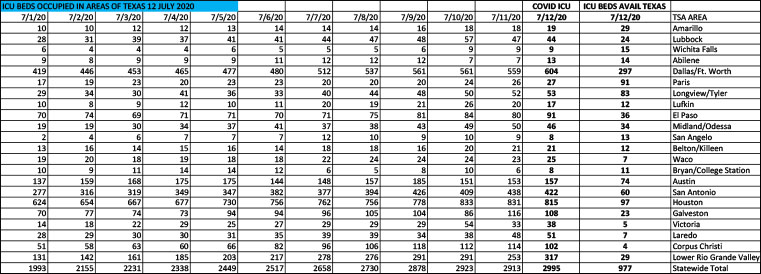
At this point, our area including Tyler and Longview is accumulating more cases but has plenty of ICU beds available at this time. The Valley hospitals are in trouble as is Houston. Dallas is doing alright, probably, but the case numbers are climbing in what is a heavily populated area. I expect we will have to shut down many things for a while yet. Harrison County and Marshall are well led and are managing nicely at this point.

Attached is a chart showing ICU availability in various areas.

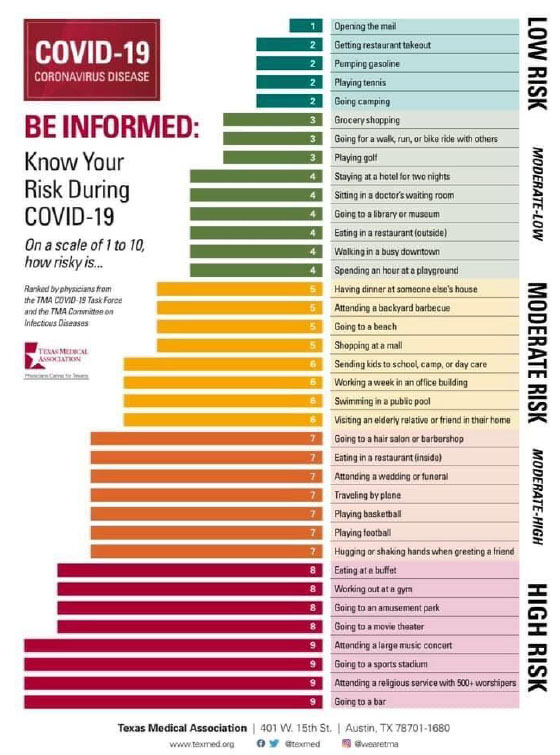
I’ve reattached the TMA Risk Chart in case you missed it yesterday. It is also attached.

I hate how funerals are always at 9 a.m. I’m not really a mourning person.

GIVE US YOUR FEEDBACK.  CLICK ON “COMMENT” TO TELL US WHAT YOU THINK or use one of the alternative methods for providing feedback.
click here to CLOSE THIS PAGE


COURTHOUSE SQUARE SURVEY MARKER INSTALLATION

HCIDA Courthouse Endowment Board

announces installation of survey markers indicating the property boundaries

determined by recent survey of the Harrison County Courthouse Square

The Harrison County Industrial Development Authority (HCIDA) Board of Directors, most commonly referred to as the Courthouse Endowment Board, shared that the official survey markers connected with the recent HCIDA-funded survey of the property associated with the 1901 restored Harrison County Courthouse and Courthouse Square in downtown Marshall, will be installed on Thursday, July 9.

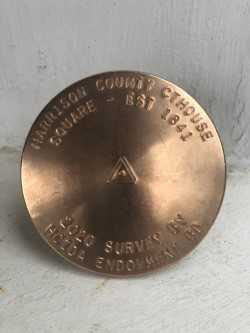
These 4-inch brass survey markers will designate the official corners and property boundaries of the Courthouse Square owned by Harrison County.

The survey of the property associated with the 1901 restored Harrison County Courthouse and Courthouse Square was recommended by the Texas Historical Commission (THC) earlier this year. The 9-member volunteer HCIDA Board voted in February to fund the survey in order to confirm the property boundaries. The survey was done in coordination with Harrison County.

Mark Patheal of MTX Surveying performed the survey, which was funded and managed by the HCIDA Board and volunteer Harrison Courthouse Manager.  Funded by the Courthouse endowment, the survey was carried out at no cost to the taxpayers of Harrison County.

Christina Anderson, president of the HCIDA Board of Directors, shared:  “We look forward to sharing with the Commissioners Court, the Texas Historical Commission, and our community the final results of the survey and the final survey report once the markers are installed and the survey is certified. It will be exciting to be able to share a definitive determination of the property boundaries not only for our community’s current purposes but also for all future purposes going forward.”

Ms. Anderson added that the HCIDA Board has kept Judge Chad Sims and the Commissioners Court, as well as the Texas Historical Commission, apprised of every aspect of the progress of the survey throughout the process.

The survey was informed by extensive historical research, legal analysis, and the compilation of relevant historical documents dating back to 1841, carried out by former Harrison County Judge Richard Anderson, who now serves in a volunteer capacity as Harrison Courthouse Manager, working with the HICDA Board in accomplishing the Board’s two-fold mission and work.

Created in 2010, the HCIDA Board of Directors has a two-fold mission a) to preserve, protect, and grow the Courthouse endowment which was established by the Commissioners Court in 2009 after the completion of the restoration of the 1901 Courthouse and b) to assist Harrison County with the ongoing preservation of the restored 1901 Harrison County Courthouse in perpetuity.

In 2009, after the completion of the restoration of the 1901 Courthouse, the Courthouse endowment was proposed and structured by then-County Judge Richard Anderson through the sale of historic tax credits and approved by the Commissioners Court.

The County transferred the proceeds from the sale of the historic tax credits in order to establish a Courthouse endowment which was created to assist the County with the ongoing preservation of the restored 1901 Courthouse in perpetuity so that the Courthouse would never go into disrepair again. As part of the HCIDA Board’s two-fold mission, the HCIDA Board has invested and managed the endowment funds so that they continue to grow for the purpose of assisting the County with the ongoing Courthouse preservation.

In recent years, in addition to the Courthouse Square survey in 2020, the HCIDA Board of Directors has carried out six other permanent improvement-related projects on the restored 1901 Courthouse. These projects include a Conditions Assessment of the restored building in 2015 to establish the permanent improvement needs going forward, as well as re-painting and repair of all exterior windows and doors of the Courthouse, the repainting of the area around the interior rotunda, replacing and installing UV-resistant sealant on the Courthouse and surrounding sidewalks, repainting the exterior handrails, and re-upholstering the 14 jury chairs in the historic courtroom.

These HCIDA projects have totaled approximately $95,000. All projects were funded and managed by the volunteer HCIDA Board and volunteer Courthouse Manager at no cost to the taxpayers of Harrison County. The Courthouse endowment is the only Courthouse endowment of its kind in the state of Texas.

The members of the HCIDA Board include Christina Anderson, President; Chief Reggie Cooper, Vice President, Veronica King, Secretary; Eric Neal, Treasurer; Dr. Blair Blackburn, Commissioner Jay Ebarb, Jack Redmon, Commissioner Zephaniah Timmins, and Amanda Wynn.

The HCIDA will share the results of the survey and more information about the process, as well as the historical research that informed the survey, once the survey is officially certified in the coming week.

GIVE US YOUR FEEDBACK.  CLICK ON “COMMENT” TO TELL US WHAT YOU THINK or use one of the alternative methods for providing feedback.
click here to CLOSE THIS PAGE


LISTEN UP

By George Smith

Listen up, Joe Biden! 

I am going to vote for you, no matter what, trusting you will, after inauguration, be choosing and working with a competent, qualified cast of cabinet and other confirmed and/or appointed aides and staff.

That said, my vote will be much easier if you agree to two conditions: 1. Choose either Susan Rice or Tammy Duckworth as your running mate; and, putting your impressive ego aside, make it clear you will only serve one term.

Face it, Joe, you are on the downhill side of elderly (78 in November); you’d be 82 before you could start your second term. Too old, okay? Too damn old.

Face it, you made a personal decision in 2014-15 not to run due to the death of your son. No one should second-guess your decision. But my opinion is, and always has been, if you had hit the primary trail against Hillary, you would be running for your second term as president now. Donald Trump did not win the presidency in 2016, Hillary Clinton lost it by assuming she was entitled to sit in the Oval Office, that her past service and resume was sufficient, that attention to detail and hard work was unnecessary.

All that aside, you have a chance to reset the Democratic Party clock by running a tight, smart race, beating the slobber jaws out of Ego Man and working at bringing the warring factions in America back to the table of compromise and bipartisan sanity in regard to programs and policies affecting a majority of citizens.

Do it. We need you, Joe, we need your experience, compassion, logical temperament  and basic sense of humanity and decency.

And, we need you to understand your limitations and unselfishly walk away at the end of one term, leaving the future to the next generation of leaders.

You have sacrificed much in the service of your country and those sacrifices will be your legacy.

Thank you for your service and thank you for ensuring the future of this nation by making the decisions necessary to rebuild trust in its institutions by every citizen.

GIVE US YOUR FEEDBACK.  CLICK ON “COMMENT” TO TELL US WHAT YOU THINK or use one of the alternative methods for providing feedback.
click here to CLOSE THIS PAGE


CORONAVIRUS INFO PROVIDED BY DR. JIM HARRIS – 6/28/2020

June 28, 2020

Three additional COVID-19 cases reported in countyThree additional COVID-19 cases reported in county
 
Marshall Manor announced Saturday that they now have 23 positive resident cases. The remaining staff and residents are anticipated to be tested on Monday.
 
The Strange Spectrum of Pandemic Response (good article and here are a few excerpts)
 
 I practice strict social distancing and remind my patients and their families to do the same. However, there are others in my state who are equally worried — but about their loss of civil liberties; they protest, refuse to wear masks, gather in crowds. Right now, I’m proud of the fact that my church has decided against holding in-person services, but there are also others in my church railing against this very decision. I think my church leaders are acting with great wisdom; others think that they are acting out of lost faith. I practice strict social distancing and remind my patients and their families to do the same. However, there are others in my state who are equally worried — but about their loss of civil liberties; they protest, refuse to wear masks, gather in crowds. Right now, I’m proud of the fact that my church has decided against holding in-person services, but there are also others in my church railing against this very decision. I think my church leaders are acting with great wisdom; others think that they are acting out of lost faith.
 
At my most tired, most burnt out, and most frustrated, I am pounding out angry words on my laptop: How can people think this pandemic is a hoax?! Face coverings are not and shouldn’t be a political statement!! Why are people hanging out in bars without masks!? Do they not care that there are hundreds of thousands of people dying from this!? Their reckless behavior is an affront to all health care workers — why are they fighting against our fight!?At my most tired, most burnt out, and most frustrated, I am pounding out angry words on my laptop: How can people think this pandemic is a hoax?! Face coverings are not and shouldn’t be a political statement!! Why are people hanging out in bars without masks!? Do they not care that there are hundreds of thousands of people dying from this!? Their reckless behavior is an affront to all health care workers — why are they fighting against our fight!?
 
I’m not sure I can say, with cold facts and hard evidence, that my worries and my responses are more rational and reasonable than those of others who think and act differently from me. However, our different perspectives and priorities seem to have shaped our pandemic response styles and pitted us against each other in some way that I fear will be detrimental when it comes to this pandemic: less solidarity, widening rifts between groups of people, more infections, more lives lost.

Evelyn Lai is a pediatric nurse practitioner with a B.A. in English Literature and a M.S. in Narrative Medicine. Evelyn has written both academically and creatively and believes strongly in the power of stories. She has no conflicts of interests. Evelyn is a 2019-2020 Doximity Fellow.I’m not sure I can say, with cold facts and hard evidence, that my worries and my responses are more rational and reasonable than those of others who think and act differently from me. However, our different perspectives and priorities seem to have shaped our pandemic response styles and pitted us against each other in some way that I fear will be detrimental when it comes to this pandemic: less solidarity, widening rifts between groups of people, more infections, more lives lost.

Evelyn Lai is a pediatric nurse practitioner with a B.A. in English Literature and a M.S. in Narrative Medicine. Evelyn has written both academically and creatively and believes strongly in the power of stories. She has no conflicts of interests. Evelyn is a 2019-2020 Doximity Fellow.

 
.Some aquatic mammals at the zoo escaped. It was otter chaos!

GIVE US YOUR FEEDBACK.  CLICK ON “COMMENT” TO TELL US WHAT YOU THINK or use one of the alternative methods for providing feedback.
click here to CLOSE THIS PAGE


News from the Blue Frog Restaurant – 6/17/2020

Dear Friends of Blue Frog Restaurant and Catering,


As we continue to evolve around and with the pandemic we want to provide you with some exciting updates!


BEGINNING Wednesday, June 17th we will offer our new LUNCH MENU (to go only) with the addition of DAILY LUNCH SPECIALS (to-go only) from 11am-2pm Monday – Friday.   The new menu with your timeless favorites can be found on our Face Book Page or give us a call to receive an email or text copy.   Daily lunch specials will also be offered as DINNER TO GO for your family of 2 or 4 (Dinner in a Bag).  Order by 2:30 pm and dinner will be packaged family style for pick up between 3:30 – 5:30 each day.


Blue Frog Market Frig, take and bake, grab and go items open Monday – Saturday 10am – 5:30 pm.  We are still offering curbside delivery for our guests who are not comfortable walking in.   


Blue Frog Catering remains open for your small or large group needs, personal chef events, special order bakery and food items.   Call or email us 903-923-9500 The Frog, 903-926-0836 Shawne (direct), bluefroggrill101@gmail.com.


The Alley Downtown (our outdoor dining area) will continue to announce evening dining events and/or live music events on a weekly basis through our face book page The Blue Frog.  Also a great way to keep up with daily specials and changes.


Blue Frog Gift Cards are a great way to show your support for our business and are available for purchase.   Give us a call or drop by the store.


Thank you so much for sticking with us. We have exciting things in the works and look forward to supporting each other during these challenging times.


Cheers,

Shawne Somerford

MARSHALL JUNE SALES TAX REPORT CITY OPENINGS

[Marshall, Texas, June 16, 2020]

On Wednesday, June 10, 2020, the City of Marshall received the June sales tax report. “I am happy to say that our overall report was lower than the previous year but better than we expected. However, we still have additional budgetary concerns moving forward,” expressed City Manager Mark Rohr.

As a result of the recent returns, the City of Marshall will enact the following provisions:

  • The Marshall Public Library will open at 50% of its total occupancy on Monday, June 22, 2020. The modified hours of operation for the library will be Monday-Friday 9:30 am-5:30 pm. To maintain social distance, a limited number of computers will be available with adequate spacing between units. Children’s interactive exhibits and games will be closed at this time to follow best practices. Patrons may still take advantage of curbside service to protect the most vulnerable populations.

  • The following city employees will return from furlough: two library employees and the Main Street Manager on June 22, 2020.

  • Effective immediately, the Human Resources department has posted employment opportunities for one police officer, one firefighter, and two ROW staff.

  • The City of Marshall will continue to hold City Commission meetings utilizing a video and audio conferencing tool and a standard conference call.  Instructions and direct links to view meetings or speak during Citizen Comment are athttp://www.marshalltexas.net.

“The City of Marshall is not in the clear yet, and all other budgetary modifications will remain in effect. Our revenue is still down compared to 2019, as we have trended downward for the last three months.  However, I believe the adjustments we have made have prepared the city well for what the rest of the year might bring as we await the July report. I am thankful for the discipline shown by the citizens and city staff as we face the challenges the pandemic has presented to us,” stated City Manager Rohr.

GIVE US YOUR FEEDBACK.  CLICK ON “COMMENT” TO TELL US WHAT YOU THINK or use one of the alternative methods for providing feedback.

click here to CLOSE THIS PAGE


LET’S TALK SYMBOLISM

By George Smith

“Symbolism is the use of symbols to signify ideas and qualities, by giving them symbolic meanings that are different from their literal sense. Symbolism can take different forms. Generally, it is an object representing another, to give an entirely different meaning that is much deeper and more significant.”

Great writers and poets often use symbolism as illustrations to present a message that may not be altogether clear.

For example, was Herman Melville’s Moby Dick really a great white whale or a symbol for something in that era’s society?

In the “Rime of the Ancient Mariner,” an albatross is the symbol of a burden the man must bear for his action.

President Donald Trump, or someone putting words in his tweeter,is a master symbolist.

On June 19th (Juneteenth), Trump is having a rally in Tulsa. In case you are isolated and clueless, June 19, in many states, is celebrated as Emancipation Day.

In Tulsa, Juneteenth is remembered for a very different reason: In June 1921, the Tulsa Race Massacre claimed the lives of an estimated 300 African Americans.

According to Human Rights Watch, “More than 1,200 houses and 35 square blocks were destroyed in just one day. By the end of the massacre, the area known as Black Wall Street was decimated, and photos showed Black people lying dead in the street.”

Trump knows this history. In a statement, Trump campaign adviser ⁦Katrina Pierson defended the move.

“As part of the party of Lincoln, Republicans are proud of the history of Juneteenth, which is the anniversary of the last reading of the Emancipation Proclamation,” Pierson wrote.

Sure. Okay. Why Tulsa? Just why?

It’s symbolism of the most crass degree: Look what happened in Tulsa 99 years ago, and the president is holding a rally to push his re-election there… why?

Symbol 2: It was announced recently the 2020 Republican National Convention to designate Trump as the GOP nominee again was being moved from North Carolina to Florida, to Jacksonville to be precise. The date set aside for the start is August 27.

Ironically, perhaps, that date is the anniversary of the ax handle and baseball bat beatings of peaceful black protestors staging a “dine-in” at a city cafeteria.

The brutal attack that became known as “Ax Handle Saturday” occurred that infamous Saturday, The Youth Council of the NAACP was participating in a peaceful protest, sitting at a whites- only lunch counter until they were spit on and attacked.

Authorities stood idly by until members of a black street gang called “The Boomerangs” tried to help those being attacked, at which point some members of the police joined in the beatings.

The victims of the attacks ran to a nearby church, finding sanctuary, until the mob disappeared.

Does Trump know the history of these dates? To think that he does not would assume this administration is operating  in a vacuum, or wants to ingratiate itself with white supremacists, racists and bigots. Or both.

Symbolism can be useful … and telling.
Trump’s use of symbolism in these two cases illustrates he is catering to his white’s-only-need-apply agenda and skewed picture of how he views America.

All believers of what America should stand for in these turbulent times should pray for a better tomorrow where race is not used as a wedge to divide the nation.

TIMELY AND PERSONAL

By George Smith

Cleon Flanagan is an American, a husband, father, production engineer, and former law enforcement officer. He is my son-in-law and dad to Bryan, 17, Brayden, 11, and Marley, 6, three of my seven grandchildren.

He is black.

He and I talked this weekend about the racial turmoil roiling through the U.S. His heart was breaking and it was obvious he was worried about the future and what new hell his biracial children would face.

So you will know, I grew up in a segregated community and never had a real, honest conversation and exchange of views about anything with any black person until I went to college. 

Cleon is the epitome of what a husband, father, relative and human being should be. He is one of the best men I have ever met. I love him.

He wrote the piece below this week. Please read it. If you do and get through it without shedding tears…you have more self control than I do. 

By Cleon Flanagan

So let’s talk … take a seat.

1980’s—Walking home, around age 12, and two white men in a pickup truck and a confederate flag waving, pulled up behind me and then beside me and threw beer and full beer cans on and at me.  Thank God I was almost home.  

1997  — When I worked for a local police agency, we were doing a transport of some detainees and prisoners when a detainee turned to me and said (while i was in uniform) “My daddy used to own some like you. ha ha!”  I couldn’t speak up. 

Same town — I went into the store to get a drink, in uniform, and the cashier looked at me (missed the badge) and said “I can’t stand f-ing n******.”

I’d like to say these instances early in my adulthood were rare, or stopped as I aged.

But that would be a “No.” 

Jennifer Thurman Flanagan and I, throughout our marriage, have endured comments that we know wouldn’t be made (or tolerated) about white couples.

“Oh, I’ll bet her family has money.  You’re all set now.”

“She has a good job so y’all know y’all will be ok. (But I’m an engineer?)

Jen has been asked if all of our kids were by the same dad.  

They are struck by the fact that she had actually graduated college, got married, and bought a house (in that order) yearsssssss before having kids.  That we weren’t teen parents.

She’s been asked at the grocery store, when the little ones were with her, if she’ll be using her Lone Star card to pay.  

She’s looked at as trash when she shops alone with our kids, but I get stereotyped as having “married up.”

And let me tell you about our recent vacations … Galveston 2019 — Our kids were questioned for missing fishing poles from a residence AN ENTIRE BLOCK AWAY.  The police were driving around and saw our kid’s fishing (with their own poles). 

Lake O the Pines 2018 — The white man who owned the property we rented was as friendly and sweet as peach pie over the phone… until he saw Bryan, his black classmate, and me heading in with our boat.  After that, we were harassed, watched, hounded, then, after cleaning profusely, he kept our deposit and sent us a bill (we got it all back after filing a complaint with VRBO).  

Speaking of vacations — How many of you have to plan your vacation depending on the demographics of the town?  The location?  Is it a place notorious for pulling over and harassing POC (people of color)?

Have you every had to justify simply being in a public place?  

Have you every been denied a day off by your boss at Thanksgiving, just for him to tell you, “Them white folks don’t want you to eat with them.”

These are only a fraction of the stories I could tell.  Imagine all of the stories millions black men and women could tell today.  

Imagine being a black man and being ridiculed and belittled by police, by your boss, by your white neighbor. treated less than human, in front of your own children who don’t understand the systematic racism that you encounter. 

And you are helpless to fight it.  You have to “stay in your place.”  You can’t speak up. 

If you think the world still doesn’t look at us differently, let me tell you:  I have a CHI (Concealed Handgun License), and I could open carry.  If I walked into Walmart with a rifle strapped to my back, the cops would be called.  White men open carry regularly – not an eye batted.  

Have you every had to tell your black son where to put his hands when he gets pulled over and to let the officer know he are unarmed?

Some of y’all get excited about your kids going off to college, traveling the world, getting jobs ANYWHERE.  That worries the hell out of me.  I don’t get the privilege to get excited for my kids — I just get to worry. 

The only reason I’m posting this is because I need y’all to understand. I have tons of white friends. I have white family members. But I really think that some don’t understand the experiences that we go through. They make assumptions that our life is great and happy and everyone is nice to us.  I’ve heard the sideways comments from people and either they think it doesn’t bother me, or they make the comment of “But you’re not like other black guys.“ What does THAT mean??

THIS IS OUR EVERYDAY REALITY!

This impacts me personally not because of my experiences that I have had or will have, but because of the experiences that my children will have. Racism is only around today because it keeps being reinforced and taught throughout the generations.  And now, it’s my kids’ turns to encounter it. And it INFURIATES ME.  

What if George Floyd was Bryan. Or our classmates, or me????

Like I was told at the police academy: Just because it happens in a big town, don’t think it can’t happen in your small piece of the world.  

Would you still sit back silent?  Would we just be a hashtag?  

Would you be complaining about protestors and rioting … or would you march for me? Would you actually act?  Would you vote differently?  Would you not make assumptions?  Would you still grasp your purse or lock your doors when we walk by?  Would we still get an interview, the job, or a promotion? 

Would you stand next to us?  

And, does it have to be someone you know for you to GET IT!?

Are you mad at the protesters?  Be mad that y’all haven’t spoken up in the names of my sons. Be mad at the systematic racism that is still plagues the every day life of POC. 

If we keep going this way, if Y’ALL DONT SPEAK UP and make SYSTEMATIC CHANGES, then it very well really might BE one of us.

Or maybe that’s it: You don’t want it to change. And THAT is the real problem.


GIVE US YOUR FEEDBACK.  CLICK ON “COMMENT” TO TELL US WHAT YOU THINK or use one of the alternative methods for providing feedback.