
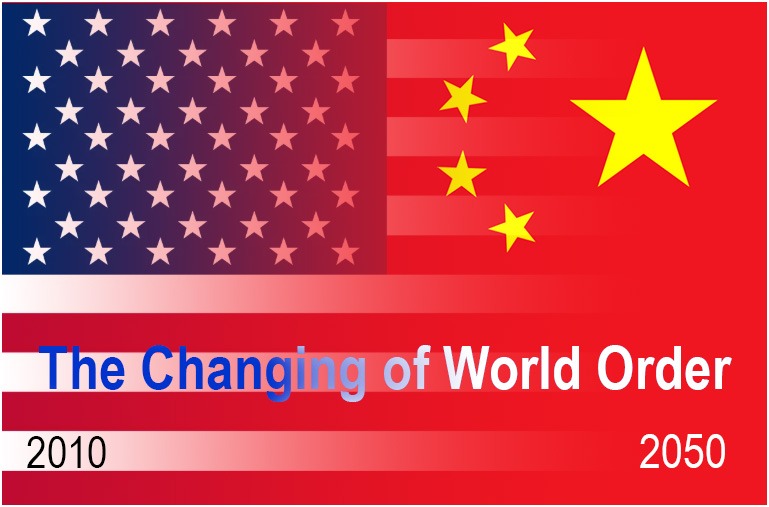
China Will Replace The United States As The Technology Leader
By Fareed Zakata – 10/5/2025
Editor’s note:
While America fights a civil war and Trump cuts funding for Advance Technology, China gets its act together and positions itself to become the world’s technology leader. This editorial by Fareed Zakata should be read by anyone that loves this country. We better wake up before it is too late. The time is short.
This is what Fareed said:
In the last decade, the United States has been comforted by the notion that China had lost its way. After 35 years of astonishing growth, Beijing stumbled internally and abroad. Its leaders cracked down on some of the country’s most innovative sectors, from technology to education, driving entrepreneurs into exile or silence. Its warrior diplomacy alienated its neighbors from Australia to Vietnam.
That era is over. China’s leaders have corrected their course. This September, while President Trump accused the UN General Assembly of being hopeless failures and harassed the UN for not hiring him to renovate its headquarters decades ago, President Xi Jinping put forward a global governance initiative to commemorate the 80th anniversary of the UN’s founding. He proposed strengthening the multilateral system along a series of dimensions, positioning Beijing as the constructive, agenda-setting superpower.
As America doubles down on increasingly idiosyncratic protectionism, threatening 100% levies on foreign-made movies, for example, China announced last week that it would no longer take advantage of any special privileges of being a developing country, a major concession sought for decades by free trade advocates. As the US levies crippling tariffs on poor countries in Africa and Asia, China has offered zero tariff-based trade to any least-developed country and some middle-income countries with which it has diplomatic relations, including 53 African nations.
Julian Goertz and Geoffrey Prescott argue in a recent foreign affairs essay that Beijing has shifted from a reactive defensive stance to a more opportunistic and strategic one. Predictable, consistent policies. There was a significant area of competition, of course, in this next year. Here, China has established a commanding lead in several areas.
In green technology, from solar panels to batteries to electric vehicles, Beijing’s dominance is now overwhelming. These act at a geopolitical level, as Beijing offers solar farms, battery plants, and electric buses to nations in Latin America, Africa, and Asia. Bloomberg has tracked 13 critical technologies and found that China now leads in five and is catching up fast in seven.
In one area, Washington still believes it has an unbelief, artificial intelligence. American firms like OpenAI, Anthropic, and Google dominate the race to artificial general intelligence. But few can define precisely the term or explain what it means to win this race. China’s approach to AI is strikingly different from China’s. Chasing AGI, Beijing has emphasized applications and diffusion. It seeks to embed AI into every corner of its economy and society, in logistics, in surveillance, in smart cities, in health care, in drones. This strategy ensures that AI quickly produces real transformation and returns, raising productivity and embeds new technology into daily life.
China has chosen a different model of diffusion, where many American firms are looking at the frontiers of AI. For five days in a row, Chinese companies are releasing OpenAI systems, most prominently Deep-Sea, that can be easily adapted and deployed. It’s an irony that Communist China now embraces open technology platforms, while the U.S. favors closed technology. It could make China’s AI a global standard, especially in the developing world, where governments and firms are eager to achieve customer satisfaction.
Add to this Huawei’s emerging dominance in 6G technology, and it’s quite possible that the technology interface for much of the world will be Chinese, not American. What makes China’s technology strategy particularly formidable is its integration across domains. It is not just building AI models. It is weaving them into hardware, infrastructure, and cities.
Consider robots. Chinese firms are producing humanoid and quadruped machines equipped with rich sensor arrays that allow them to see and think in real environments. Just last year, China installed almost nine times as many industrial robots as the United States. Or take drones, and yes, flying cars. China is building what it calls a low-altitude economy, carving out urban airspace for autonomous aerial vehicles. In Shenzhen, drones already deliver packages. Self-driving cars have begun taking passengers. Again, the advantage is integration. Sensors, AI, hardware, and regulation are aligned to create transformative technology.
Meanwhile, in the United States, government funding for basic science and technology has been slashed. Our best universities are under siege, with the government launching a war to take down Harvard by many measures, the world’s top-ranked research university. While the government is on the verge of shutting down in Washington, the President and Secretary of Defense summoned hundreds of the country’s top generals to lecture them on staying slim and fighting woke ideologies. We need to get serious.
EastTexasExposed.com
P.O. Box 721 – Scottsville Tx 75688


 iEXPOSED.us Blog