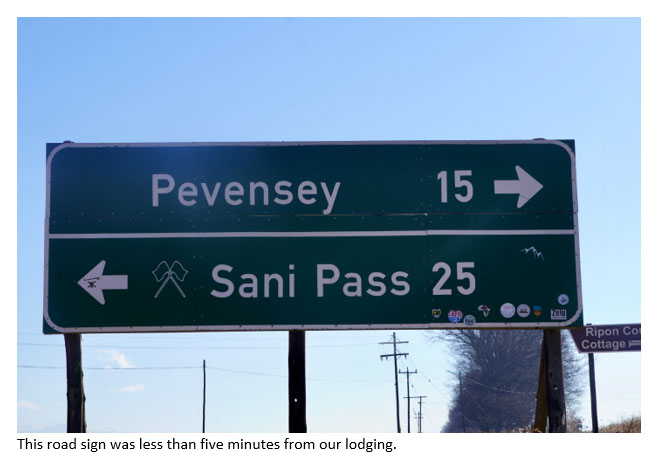
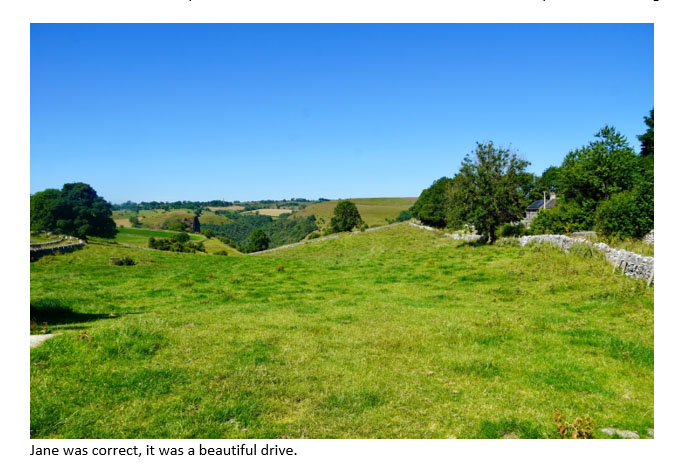
Black Top Farm to Manchester – 10 July 2022 – United Kingdom

Editor note:

More from Tom  

By Tom Allin

While we were eating breakfast, Jane came out of the kitchen and asked us where we were going today.  I answered we were driving to Manchester.  Immediately she said she would write out the most scenic drive for us to take to Manchester.  Then Jane’s visiting girlfriend from Manchester said not only would it be scenic but no slower due to all the Sunday traffic on the highway.  I knew anything scenic meant narrow roads but I am slowly getting used to closing my eyes, steady on the gas pedal, and praying for divine intervention.

During yesterday’s walk from the farm to Hartington and back I had a heart-to-heart talk with myself.  I reminded myself I had survived six months of driving in India – a country where driving is the art of the insane, roads are narrow with everything on them but cars, certifiable crazy taxi drivers everywhere, and don’t forget cows, oh yes and buses.

Use the links below to read Tom’s complete story

CLICK HERE TO READ THE COMPLETE STORY

ANDROID USERS CHICK HERE TO READ THE COMPLETE STORY

***********************************

GIVE US YOUR FEEDBACK.  CLICK ON “COMMENT” TO TELL US WHAT YOU THINK or use one of the alternative methods for providing feedback.

Click here to submit feedback.  Let us know what you think.

click here to CLOSE THIS PAGE

1792 case reveals

July 27, 2022

*****************************

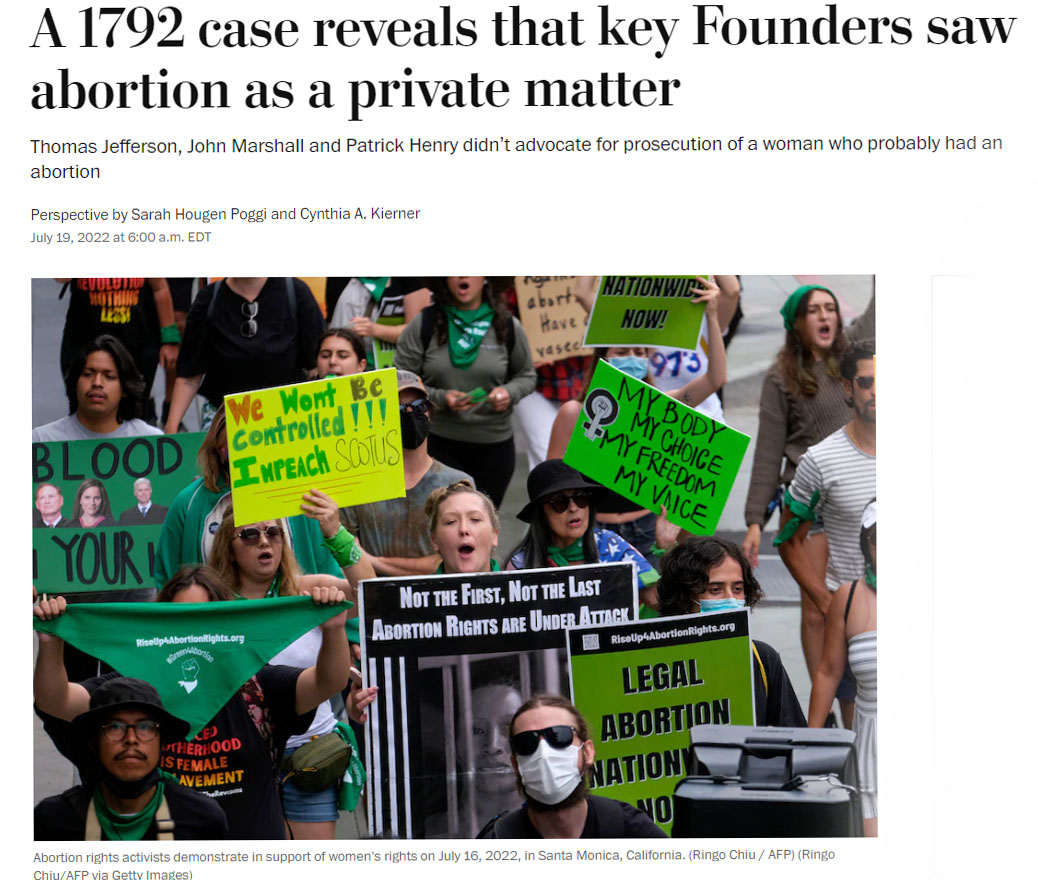
A 1792 case reveals that key Founders saw abortion as a private matter

******************

Editor’s comment:

I published this story at Tom Allin’s request.  As always I will be happy to publish rebuttals to this article.

Opening Remark:

“I have asked Ron to publish the article below.  It is written by a friend’s daughter, Dr. Sarah Poggi, who we also consider a friend.  It is always interesting to me how those who want a strict interpretation of the Constitution only want it when it fits their false facts (or leave out all the facts) rather than the historical facts.  See article below.”

Tom Allin

MADE BY HISTORY

A 1792 case reveals that key Founders saw abortion as a private matter

Thomas Jefferson, John Marshall and Patrick Henry didn’t advocate for prosecution of a woman who probably had an abortion

Perspective by Sarah Hougen Poggi and Cynthia A. Kierner 

July 19, 2022 at 6:00 a.m. EDT

A basic premise of Supreme Court Justice Samuel A. Alito Jr.’s majority opinion in Dobbs v. Jackson Women’s Health Organization was that the Constitution can protect the right to abortion only if it is “deeply rooted in our history and traditions.” This statement complements Justice Amy Coney Barrett’s concept of originalism, or the idea that the court should interpret the Constitution by trying to infer “the meaning that it had at the time people ratified it.”

Alito’s evidence that abortion was always considered a criminal act, and thus something the Constitution should not protect, consisted of a single criminal case that was prosecuted in 1652 in the (Catholic) colony of Maryland. He then jumped ahead to laws that states enacted, mostly in the mid-to-late-19th century, to criminalize abortion. This cursory survey of abortion in early America was hardly complete, especially because it ignored the history of abortion in the years in which the Constitution was drafted and ratified.

In that era, abortion was governed by Anglo-American common law. Under this framework, the procedure was legal before “quickening,” or the moment the pregnant person first felt fetal movement — a highly subjective milestone that usually occurred around 16 to 22 weeks of gestation. Yet even after quickening, few people were prosecuted for abortion, let alone convicted — Alito’s opinion certainly did not offer contradictory evidence. The reason is simple: In the early republic, abortion was largely a private matter. It was not a cause for public concern, nor was abortion considered a criminal act.

In fact, contrary to Alito’s assertions in Dobbs, three Founders from Virginia — Thomas Jefferson, Patrick Henry and John Marshall — did not seek charges in a sensational court case from that era in which evidence of an abortion was discovered.

In 1792, 18-year-old unwed Nancy Randolph was impregnated by her 22-year-old brother-in-law and cousin, Richard Randolph. Nancy lived with Richard and his wife, her sister Judith, at their Cumberland County plantation in Virginia, aptly named “Bizarre.”

In September, Nancy and Judith’s cousin and sister-in-law, Jefferson’s daughter Martha Jefferson Randolph, visited and found Nancy unwell and unwilling to undress in front of her. Martha, who believed Nancy was pregnant, recommended gum of guaiacum, an herb known to treat “menstrual obstruction,” a euphemism for pregnancy. On her return home, she sent Nancy the herb, which she warned could “produce an abortion.”

Two weeks later, Richard, Judith and Nancy visited the home of their cousins, Randolph and Mary Randolph Harrison. Nancy appeared ill and retired early to bed, awakening with a scream in the middle of the night. The next morning, Nancy’s bedclothes were bloody. Randolph Harrison saw blood on the stairs and noted “[Nancy’s] considerable paleness and a disagreeable odor.”

When an enslaved man found what appeared to be a White fetus on a woodpile, rumors spread through the community of enslaved people to Whites of all classes quickly, reaching Philadelphia, where Jefferson expressed sympathy for Nancy in a letter to daughter Martha, declaring: “I see guilt but in one person, and not in her.” Jefferson’s response was typical of that era, a time when upper class White women like Nancy were viewed as morally pure and sexually chaste by nature.

Many among the general public believed that Richard impregnated his sister-in-law — which was incest under Virginia law — and that he also murdered a living infant. His honor and life were at risk. Richard vehemently asserted his innocence in a newspaper. His public statement had little effect, and, facing mounting pressure, he surrendered to the county sheriff. Richard was charged with “feloniously murdering a child delivered of the body of Nancy Randolph or being accessory to the same.”

Medically, five pieces of evidence suggest that what happened was not murder of a living child, but rather a deliberate second-trimester abortion. First, Nancy had an abortifacient. Second, witnesses reported her enlarged abdomen, though not a full-term pregnancy. Third, Nancy’s brief cries were more consistent with latent labor than active labor. In latent labor, the cervix dilates to four-to-six centimeters, sufficient for passage of a one-to-two-pound fetus. Uncomfortable but not unbearable, and sometimes lasting days, latent labor in the second trimester ends abruptly with the expulsion of the fetus. (At full term, hours of painful active labor follow to achieve 10-centimeter dilation and pushing efforts.)

Fourth, no one reported a baby’s cry, suggesting pre-viability outside the womb. Finally, Nancy later delivered a son at term, indicating she had no risk factors for second-trimester miscarriage such as uterine or cervical anomalies. Altogether, the evidence supports the conclusion that Nancy ingested herbs to induce a second-trimester abortion and that her effort was successful.

In April 1793, Richard appeared before a tribunal of county judges who weighed the merits of serious criminal charges to decide whether they should be adjudicated in a higher court. Few defendants in the 1790s had legal counsel, but Richard and his stepfather assembled a good team: Henry, a charismatic litigator and former governor famous for his “Give me liberty or give me death” speech; Marshall, a rising star and the future U.S. Supreme Court chief justice; and William Campbell, the U.S. attorney for Virginia.

The circumstantial obstetric evidence overwhelmingly demonstrated that Nancy’s pregnancy ended that night at the Harrisons’ home. Marshall recorded Martha Randolph’s testimony that Nancy was pregnant and that she delivered the herb, noting that the gum of guaiacum was “designed” for producing an abortion. But he did not describe this as a crime.

No effort seems to have been made to determine whether the pregnancy had reached the stage of quickening. If it was post-quickening, the state could have prosecuted Nancy and Martha. Instead Henry skillfully undermined the credibility of the prosecution’s witnesses, and Marshall successfully took the untenable position that there was never a pregnancy and, thus, Richard could not be guilty of murder.

While the release of Richard — a wealthy White man with great lawyers — was not surprising, what was remarkable and relevant to today’s debates is that evidence of an intended abortion was discovered in an unwed, unpropertied woman and not fully investigated or acted upon. Nancy would later admit she had been pregnant, yet neither she nor her accomplice were ever charged.

Abortion was later criminalized in Virginia and across other states in the 19th century. But these laws reflected the development of modern gynecology more than a change in morality. The curette, introduced in 1843, was widely adopted when dilators were developed in 1871, resulting in the “D and C” procedure, in which the cervix is dilated to allow for passage of a curette, which removes tissue from the uterus. Abortion transformed from a private, female matter to the purview of male medical professionals, who excluded other providers by influencing lawmakers.

Therefore, the more historically accurate conclusion is Justice Harry A. Blackmun’s majority opinion in Roe v. Wade (1973), that “at the time of the adoption of our Constitution, and throughout the majority of the 19th century, abortion was viewed with less disfavor than under most American statutes currently in effect. Phrasing it another way, a woman enjoyed a substantially broader right to terminate a pregnancy than she does in most States today. ”

Though Marshall’s notes on Commonwealth v. Randolph are extensive, this episode is poorly documented in the county court records, and, thus, no formal case law was generated. Regardless, the episode begs examination as it involved key Founders who occupied vastly different positions on the political spectrum, both nationally and in Virginia. The Federalist Marshall believed in a strong national government. Jefferson mostly supported a decentralized system. Henry was a populist. Yet all three tacitly agreed that abortion in this case was a private matter, not a criminal act worthy of further investigation and prosecution. In a remarkable coda, Nancy went on to marry Gouverneur Morris of New York, an influential signer of the Constitution, who was well aware of her backstory.

If anything, the saga demonstrates that the concept of abortion as a private matter was “deeply rooted” in the minds of our nation’s Founders. As Americans consider their next move on the abortion issue at the state level, they should be mindful of the precedents followed by these early giants of our republic.

***********************************

GIVE US YOUR FEEDBACK.  CLICK ON “COMMENT” TO TELL US WHAT YOU THINK or use one of the alternative methods for providing feedback.

Click here to submit feedback.  Let us know what you think.

click here to CLOSE THIS PAGE

—————————————————————–

Click here to go to the iExposed.us youtube channel

Click here to go to the iExposed.us website

—————————————————————–

EastTexasExposed.com

iExposed Us 

P.O. Box 721

Scottsville Texas

75688

The Peaks – 9 July 2022 – Hartington, The Peaks, United Kingdom

Editor note:

More from Tom  

By Tom Allin

On 8 July we arrived mid-afternoon at The Black Top Farm two tenths of a mile outside of Hartington. We checked in for two nights and unloaded our stuff. Then drove back into town to find dinner – Jane, our hostess, told us without reservations we may have to drive to another town for dinner. That was all the motivation we needed to immediately get back to Hartington.

Our first stop didn’t serve meals but the second did. Most importantly the second said if we would sit down they would serve us before all their tables were filled with guests from their lodge or tonight’s other reservations. Didn’t have to ask twice.

The next morning we were downstairs eating breakfast by 8:30. The word, hearty, hardly describes all the food. The following morning, we let Jane know we didn’t need the beans or the meat. My favorite was the oat cakes, flat like our pancakes but with a very different taste to them. Nancy liked the oat cakes but said the eggs may have been the best tasting she had ever had; this from a person who eats eggs for breakfast at least 29 mornings out of 30.

Use the links below to read Tom’s complete story

CLICK HERE TO READ THE COMPLETE STORY

ANDROID USERS CHICK HERE TO READ THE COMPLETE STORY

***********************************

GIVE US YOUR FEEDBACK.  CLICK ON “COMMENT” TO TELL US WHAT YOU THINK or use one of the alternative methods for providing feedback.

Click here to submit feedback.  Let us know what you think.

click here to CLOSE THIS PAGE

Out in the Countryside – 7 July 2022 – East Anglia, United Kingdom

Editor note:

More from Tom  

By Tom Allin

A Note from Tom – July 17, 2022

Yesterday the high was 71.  Today the high is predicted to be 88.  Monday 96.  And Tuesday 103.  But Wednesday its back to 73.  Keep in mind our apartment has no air conditioning.  

Nothing like being in the UK when it is having one of its hottest hot spells.  My favorite headline: Climate models predicted current heat — in 2050.  The climate deniers continue to be correct — the models are not perfect; the models keep predicting cooler weather than is occurring!

Stay cool, safe, healthy and avoid the Covid.

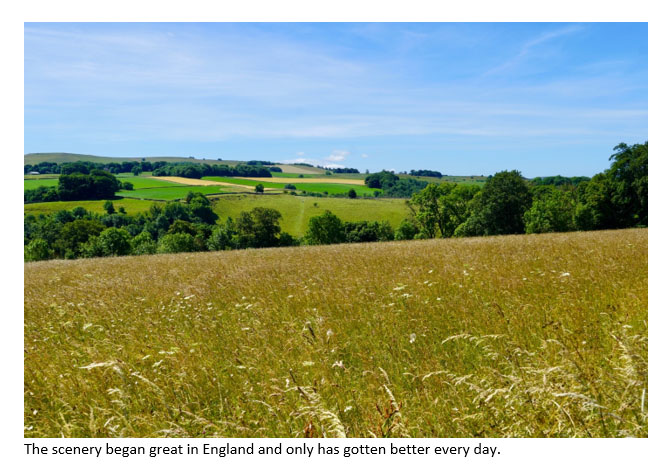
Out of the city and into the countryside.  Life is better: no jet lag, Nancy’s bag finally arrived, and we are walking paths not cobblestone streets and sidewalks.

U-turn and continue walking the broad pathway with very little to look at.

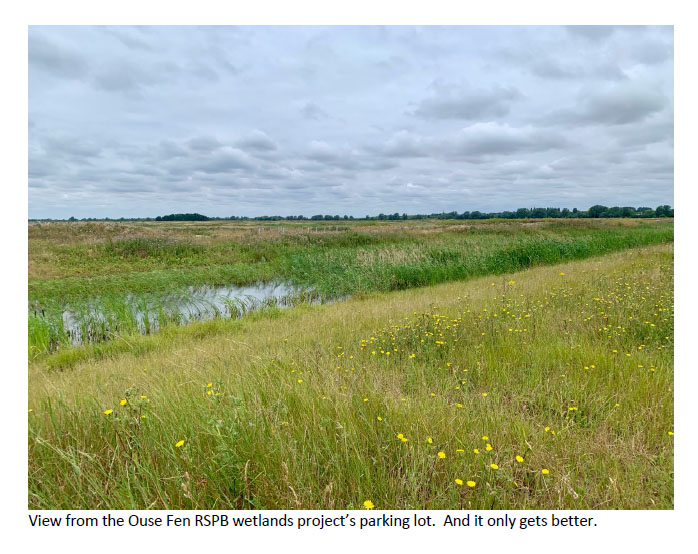
The plan for today is to stop at three Royal Society for the Protection of Birds nature reserves.  The Royal Society for the Protection of Birds (RSPB) was begun in 1889 and is the largest nature conservation charity in the United Kingdom.  There are more than 150 reserves spread across the UK.  For more on the RSPB go to: https://www.rspb.org.uk

Use the links below to read Tom’s complete story

CLICK HERE TO READ THE COMPLETE STORY

ANDROID USERS CHICK HERE TO READ THE COMPLETE STORY

***********************************

GIVE US YOUR FEEDBACK.  CLICK ON “COMMENT” TO TELL US WHAT YOU THINK or use one of the alternative methods for providing feedback.

Click here to submit feedback.  Let us know what you think.

click here to CLOSE THIS PAGE

Windsor Castle – 4 July 2022 – England, United Kingdom

Editor note:

More from Tom  

By Tom Allin

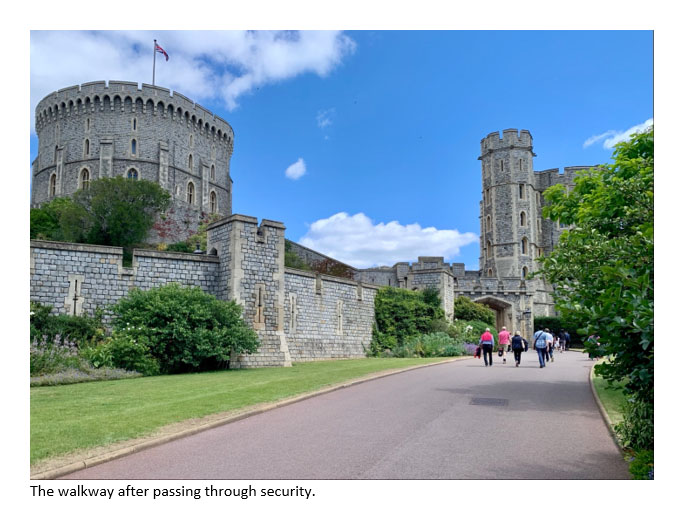
I am a fan of Rick Steves but I believe he mislead me.  His book on Great Britain notes Windsor Castle as being in the surrounding area of Cambridge.  I booked two on-line tickets and then Google mapped our route only to discover it was a two-hour one-way trip.  Not exactly what I envisioned or had in mind for an in the neighborhood drive.

We presented our tickets and were passed through to security.  I had forgotten that in England and most likely all the United Kingdom (and of course any airport) a pocketknife is treated as a weapon of mass destruction.  It was bagged, tagged and I was told I could pick it up after we left the Castle.  All this for a pocketknife: have to wonder what would happen if a concealed gun packing American tourist showed up.

At the top of the rise in the first photograph is a gated entrance into a portion of the castle grounds. The gate is locked, no entry. From here you complete what is a walking U-turn and continue walking the broad pathway with very little to look at.

Use the links below to read Tom’s complete story

CLICK HERE TO READ THE COMPLETE STORY

ANDROID USERS CHICK HERE TO READ THE COMPLETE STORY

***********************************

GIVE US YOUR FEEDBACK.  CLICK ON “COMMENT” TO TELL US WHAT YOU THINK or use one of the alternative methods for providing feedback.

Click here to submit feedback.  Let us know what you think.

click here to CLOSE THIS PAGE

We Are in Lesotho – 25 June 2022 – Lesotho

Editor note:

More from Tom  

By Tom Allin

Yesterday was another birding day but with a different bird guide named Aldo.  Not only was Aldo a great guide but he was willing to talk about anything and everything when it came to South Africa.

A friend dropped him at our place.  To keep the cost down I drove the 4Runner and at the end of the day we left Aldo at his home.  Of course, he had bird feeders and therefore birds in his yard and we picked up one last new bird at his house.

I took no photographs of our birding trip – my mistake.  Like so much of South Africa the area we drove and birded was beautiful.  So, I am going to talk about our birding trip and what we learned from Aldo about South Africa in between photographs of our drive up the Sani Pass and into Lesotho.

Use the links below to read Tom’s complete story

CLICK HERE TO READ THE COMPLETE STORY

ANDROID USERS CHICK HERE TO READ THE COMPLETE STORY

***********************************

GIVE US YOUR FEEDBACK.  CLICK ON “COMMENT” TO TELL US WHAT YOU THINK or use one of the alternative methods for providing feedback.

Click here to submit feedback.  Let us know what you think.

click here to CLOSE THIS PAGE

Sani Pass – 23 June 2022 – South Africa/Lesotho

Editor note:

More from Tom  

By Tom Allin

Yesterday was a long drive for us.  We drove from Umngazi River Bungalows & Spa to a guest house in Himeville.  This was 300 km/180 miles or a five hour drive if you make no stops; we stopped.

But this was a worth while drive.  We had two days of birding with guides lined-up, the first guide was to take us up the Sani Pass and into Lesotho and then back and the second bird guide was to show us the birds around Himeville.  The following day we were to make the drive up to and over the Sani Pass, into Lesotho, and find a place to stay.

We arrived at our guest house late in the afternoon.  Our lodging was a guest house inside a gated compound that consisted of a living area with small fireplace, a kitchen, a bedroom and bathroom plus the owner’s home.  Nancy didn’t waste any time in our guest house before asking the owner, “Do you have a heater?”  Her reply was no but she would go next door and borrow one for us.  Even with the heater and two blankets we slept very close to each other.

That evening while I was keeping the fire in the fireplace going Nancy got creative with the food we had in the 4Runner and made dinner.

Use the links below to read Tom’s complete story

CLICK HERE TO READ THE COMPLETE STORY

ANDROID USERS CHICK HERE TO READ THE COMPLETE STORY

***********************************

GIVE US YOUR FEEDBACK.  CLICK ON “COMMENT” TO TELL US WHAT YOU THINK or use one of the alternative methods for providing feedback.

Click here to submit feedback.  Let us know what you think.

click here to CLOSE THIS PAGE

Tidal Pool Tour – 1 June 2021 – De Hoop Reserve, South Africa

Editor note:

More from Tom  

By Tom Allin

Birds in the morning and little animals in the tidal pools along the coast in the afternoon.  The birding tour we had the guide to ourselves but the tidal pool tour we had to share the guide with two other couples.  There are advantages when traveling during the time of a pandemic – fewer people that you must share the guides with.

The De Hoop Reserve has some very large coast sand dunes.

Use the links below to read Tom’s complete story

CLICK HERE TO READ THE COMPLETE STORY

ANDROID USERS CHICK HERE TO READ THE COMPLETE STORY

***********************************

GIVE US YOUR FEEDBACK.  CLICK ON “COMMENT” TO TELL US WHAT YOU THINK or use one of the alternative methods for providing feedback.

Click here to submit feedback.  Let us know what you think.

click here to CLOSE THIS PAGE

A Real Nail-Biter

By Ron Munden — started 11/28/2021 -> finished 7/5/2022

Have you ever dreamed you failed to pay 10,000 people?  I had this  nightmare and I was awake.  

Today I received an email from my bank.  It said that my December retirement check had been deposited into my account by the Federal Reserve one day early.

This email sent old memories flooding back into my mind.

In the mid-1980s I was moved from the Head of Technical Support for the Design Division position into the Head of Information Resources Management (IRM) for Mare Island Naval Shipyard.  Two weeks into my new job an incident occured that remains crystal clear in my mind today.

One of the responsibilities of IRM was processing payroll data and generating a computer tape that could be delivered to the Federal Reserve (FR) in San Francisco.  The Federal Reserve processed the tape and sent electronic transactions into the country’s banking system and deposited funds into the accounts of the 10,000+ people working at Mare Island Naval Shipyard.

The process is repeated every two weeks.  On Monday the payroll for the previous two weeks was processed on swing shift at Mare Island.  Tuesday morning the tape was hand delivered to the FR.  That evening the FR used the tape to generate the transactions that would deposit the pay into MI employees’ banking accounts.  On Thursday night all 10,000 employees’ bank accounts were credited with the pay for the previous two weeks.  On Friday morning the funds were available for use. 

This process had been used for the prior couple of years without a problem.

This time we ran payroll and the Comptroller Department took the tape to the FR Tuesday as scheduled.

On Tuesday night I was at home having dinner when I received a call from a computer operator at the FR.  He told me that our magnetic tape had failed validation at the FR and they could not process Mare Island’s payroll.

I was not really worried when I got off the phone.  I knew magnetic tapes were not completely reliable and we have to rerun jobs from time to time.

On Wednesday morning I got to the shipyard at about 6:30am.  I noticed the schedulers in operations that we were going to need to re-run payroll and generate a new tape to take to the FS.  My next call was to the Comptroller, a Navy Captain.  I explained the situation.  He said that he would have the Deputy Comptroller dive it to the FR and wait to ensure it passed validation.

We re-ran payroll and got it to the FR by mid-morning.  

Just before noon the Comptroller walked into my office and told me that his Deputy had just called and said the new tape had failed validation.  This was the point that the Comptroller and I both realized we had a serious problem.  If we could not pay people on Friday, there were going to be a lot of bounced checks Friday night. 

Our problem was complicated by the fact that our office did not write the software that was failing.  It was written by a central design agent on the East Coast.  We reported the problem to them but the group was not known for quick responses so we could not count on them to fix our problem.

We started looking for solutions.  The shipyard had been using this software for about 6 months.  Prior to that we printed checks and distributed them on Friday at the Shipyard.  We thought we could go back to the old software and print checks bypassing the FR electronic processing.  A quick look at check form inventory showed that we did not have enough checks in stock to print 10,000 checks.

That left us with only two alternative:

  1. Find the error in the payroll software and fix it or
  2. Modify the magnetic tape going to the FR so it would pass validation.  

We also recognized we had to develop a plan of action to address the possibility that we could not get the people paid.

I took the lead on 1 and 2 approaches.  The Comptroller finalized his plan of action if alternative 1 and 2 both failed.

It is now mid-afternoon on Wednesday and the drop-dead for FR processing was late-afternoon Thursday without special processing by the FR.  

I used the Admiral Rickover approach by assigning different teams  to work in parallel and trying to solve a problem using two different approaches.

We assigned the two best Cobol coders to read the payroll source code listing and try to find any coding errors that might be causing the problem.

A second team of engineers started writing computer C code to read the payroll output tape and recalculate the tallies that the FR  expected so the modified tape would pass validation.  I worried a little about if this was legal but the vision of the Comptroller and I hanging from a crane on the waterfront trumped the legal concern at this point.

Meanwhile the Comptroller scoped out the size of the problem.  As I mentioned at that time the shipyard employed about 10,000 people.  Those people used 54 banks in the Bay Area.

The Comptroller wrote a letter that would be hand delivered to each of the 54 banks first thing on Friday if our efforts to fix the problem failed.  Each letter had an attachment listing the name and bank account number for each person doing business with that bank.   The letter quickly outlined the problem and asked the banks to honor all checks listed in the attachment.  It also committed the Shipyard to pay all the bank charges resulting from any account overdraws.

At about 6pm the Comptroller stopped by the office.  I briefed him on my status. I calculated we had about 12 to 14 hours to fix the problem and deliver a good magnetic tape to the FR.  I told the Comptroller we would work through the night and with luck we would have a tape that would pass validation before 8am Friday morning.  The Comptroller said he could not be much help but he could keep us supplied with coffee and donuts.

He was true to his word.  Every couple of hours he would drop by our office with more coffee and donuts.

At about 3am Thursday morning the Cobol programmers came to my office and said that they thought they may have found the bug.  They showed another manager and me the code.  There was a problem but was that the only problem?  They ask if they should continue looking?  I did a quick calculation in my head and decided we had run out of time.  I told them to stop looking and start fixin.  I also allerted computer operations  to prepare to re-run payroll again. 

The programmers made the corrections to the source code and recompiled the corrected code.  They were very careful because everyone knew we only had one change to get it right.

By 6am we were ready to re-run payroll and cut a new tape.  By 10am the Deputy Comptroller had the tape and was driving to San Francisco.

Then the hard part – we wait to see if the tape would pass validation.  Before 2pm we got the call.  The tape passed validation at the FR.  The transaction would be loaded into the banking system on its next run.  Money would be in employee bank accounts Friday morning.

It had been a long two days. We were all very happy people.  The image of the Comptroller and yours truly hanging from a crane on the buildways slowly faded from my memory,  replaced by a team working together.

Footnote:

After more research we knew what had happened.  The software had worked and paid personnel in all the shipyards for 6 months.  That was about 80,000 people.  Why did it stop working at Mare Island?

There are 8 Federal Reserve banks in the country.  The software should have been able to handle payments going through more than one FR bank but for the previous 6 month all shipyards had all their employees using a single FR bank.

For years Mare Island supplied employees to  work at a prototype nuclear reactor site in New York state.  The assignments were usually 3 to 6 months. During these assignments no employee had ever opened a bank account in NY and had their paycheck deposited into that account.  The week before our payroll run failed validation, one employee did exactly that. The payroll software had a bug.  It only worked when all the deposits went to a single FR bank.  Therefore, our payroll contained data for two FR banks and the central design agents software generated tallies that could not pass validation.

We notified the central design agent in Washington of the problem.  They issued a software fix to all of the shipyards prior to the next pay date. 

I stayed in the IRM job for another 7 or more years.  We ever had another nail-biter moment like this during that period.  What a way to start a new job.

***********************************

GIVE US YOUR FEEDBACK.  CLICK ON “COMMENT” TO TELL US WHAT YOU THINK or use one of the alternative methods for providing feedback.

Click here to submit feedback.  Let us know what you think.

click here to CLOSE THIS PAGE

—————————————————————–

Click here to go to the iExposed.us youtube channel

Click here to go to the iExposed.us website

—————————————————————–

iExposed Us 

P.O. Box 721

Scottsville Texas

75688
The Grand Old Flag

Seventy-nine Years

July 2, 2022

*****************************

The Grand Old Flag Ain’t What It Used To Be

******************

By Ron Munden

I woke up this morning and just like that I was 79 years old.  I am glad that I am still kicking but  I am more pessimistic than I have never been  in my life.

Up until the mid-1990s I was one of the most optimistic people around.  I saw a bright future for this country.  We had defeated the Soviet Union and we were the dominant world power.  We were calling the shots.

In the 90s I did see one cloud on the horizon – our failing education system.  By this point our education system was no longer rated the best in the world and the trend was downward.  I still thought there was time to correct our course.

I come from the technology world.  I spent 35 years working for the Department of Defense — first as a government worker then a contractor for DoD. I strongly believe that the nation with the best technology will dominate the world and the keys to having the best technology are a great education system and a government that invests heavily in research and development.

In the 1990s I did not recognise this second key was also in decline.

In retrospect the 1970s were the start of the decline.  In the 1970s the country decided to cut taxes on the rich.  After all, the rich were better at managing money than the government.  This is partially true.  They knew how to buy politicians.

When taxes for the rich went down, so did the government’s investment in infrastructure and research and development.

The financial experts decided that it was cheaper to manufacture our products in other countries because of the cheap labor.  So we shipped our jobs and our technology to other countries in order to increase company profits.  

In the early 2000s our leaders decided it would be good to fight a needless war so we attack Iraq.  So our country spent 15 years spending money on fighting wars while China spent its money on research and development as well as stealing our technology.

Of course we can’t forget that since about 2016 this country has been engaged in a civil war between the right-wing and left-wing extremes in the country.  Since both teams are roughly equally matched, we can expect this harmful conflict to continue into the future.  And we can expect it will increase.

Climate change adds an additional stresser.  Our country has not taken it seriously. Neither has the rest of the world.  As the world leader we had the responsibility to lead not to deny.

I know that there are many in our country that deny climate exists because that is inconvenient. These people will not change their minds until the air conditioning unit fails and they begin roasting within their own skins.

While the people in the USA fight each other, China continues its move toward world domination.  Today, the United States no longer has the fastest computers.  China does.  Built with Chinese designed parts in China.

In war game simulations at DoD, the US easily defeats Russia.  In match ups with China, China is the winner over the US 6 out of 7 times.

In the early 1980s I heard a lecture by Dr. Forester, a professor from MIT.  He was an engineer turned economist.  His lecture focused on how short term solutions are always diametrically opposed to long term solutions.   Dr. Forester expressed concern about the long-term future for the United States because it always takes a short-term approach to problem solving. 

China plays the long game; the US the short game.  Soon we will see that Dr. Forester had a valid concern. 

I am glad I was born 79 years ago.

I thank God each day for being born to parents that were part of the greatest generation this country has ever known. I thank God for allowing  me to be able to have lived in the greatest nation on earth – heads and shoulders above all others.  I thank God that I was not born in 1953 or 1963 or not 1973 because my generation will be gone soon.  We will not have to live through the demise of this once great nation.

***********************************

GIVE US YOUR FEEDBACK.  CLICK ON “COMMENT” TO TELL US WHAT YOU THINK or use one of the alternative methods for providing feedback.

Click here to submit feedback.  Let us know what you think.

click here to CLOSE THIS PAGE

—————————————————————–

Click here to go to the iExposed.us youtube channel

Click here to go to the iExposed.us website

—————————————————————–

iExposed Us 

P.O. Box 721

Scottsville Texas

75688